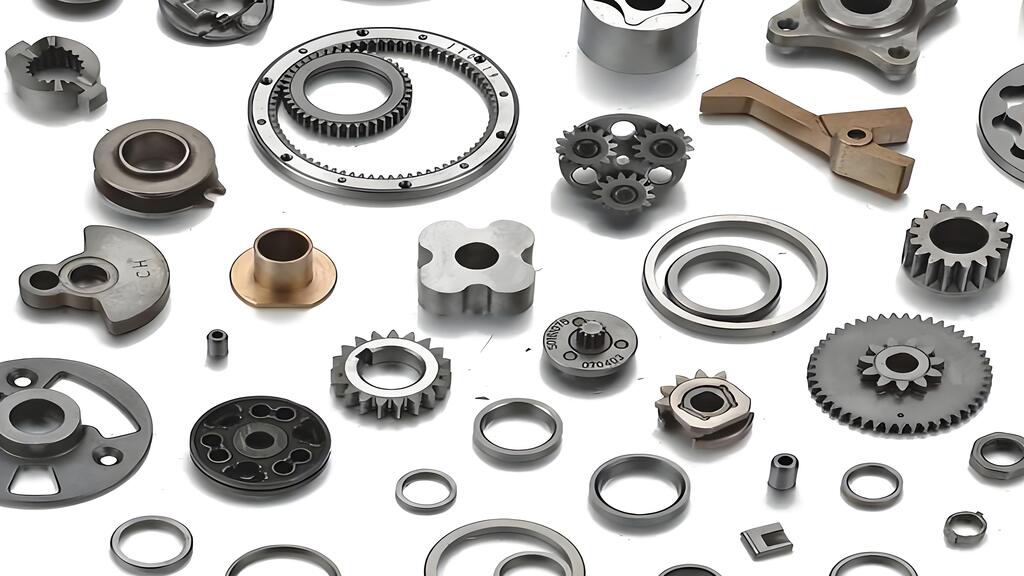


How Iron Powder Sintering Works
How Iron Powder Sintering Works: A Practical Guide for Modern Manufacturing
Key Takeaways
Iron Powder Sintering transforms loose metal particles into strong, precise components through controlled heating below melting point, offering manufacturers a cost-effective alternative to traditional machining and casting methods.
• Sintering bonds particles through solid-state diffusion at 70-90% of melting temperature, creating metallurgical bonds without liquefaction
• Three-zone furnace process removes lubricants, enables particle bonding at 1120-1150°C, and prevents oxidation during cooling
• Controlled porosity ranges from 5-25% enable specialized applications like self-lubricating bearings and oil-impregnated components
• Automotive industry consumes 70% of ferrous Powder Metallurgy products, achieving ±0.022mm tolerances in transmission gears
• Proper atmosphere control using hydrogen-nitrogen mixtures prevents oxidation and ensures optimal mechanical properties
The sintering process enables net-shape manufacturing with 95% material utilization, making it ideal for high-volume production where dimensional accuracy and cost control are paramount. Modern applications span from automotive components to additive manufacturing post-processing, demonstrating the technology's versatility across manufacturing sectors. 
Understanding Iron Powder Sintering Fundamentals

What is Sintering in Powder Metallurgy
Sintering represents a thermal process where powdered materials bond through heating to produce solid, three-dimensional parts. Temperatures stay below the material's melting point. Powder particles fuse together through atomic diffusion rather than liquefaction. Atoms move across particle boundaries when iron powder undergoes sintering. They form necks at contact points that grow progressively stronger as the process continues.
Differences in bulk pressure, vacancy concentration, and vapor pressure between particles drive this bonding. Surface energy reduction serves as the main motivation for particle bonding. Powders possess very high surface area relative to their volume. This creates elevated surface energy that the system naturally seeks to minimize. So atoms migrate from areas of higher chemical potential to regions of lower chemical potential. The total surface area reduces and the structure combines.
Diffusion emerges as the most important sintering mechanism. This movement occurs under vacancy concentration gradients, where atoms exchange positions with vacant lattice sites. Particles sinter under a quasi-equilibrium state. Diffusion gradients reach steady state quickly compared to changes in particle geometry. Multiple mass transfer phenomena occur at once: grain boundary diffusion, surface diffusion, lattice diffusion, and plastic flow.
The sintering process transforms the agglomeration of individual particles into an agglomeration of crystals. What begins as a pressed powder compact with weak bonding between particles develops into a cohesive material with metallurgical bonds. Necks form between particles during early stages and expand through continued atomic movement. They eventually create a unified metallic structure with controlled porosity.
How Sintering Is Different from Melting
The fundamental difference between sintering and melting lies in the material's phase state during processing. Sintering occurs at temperatures between 70-90% of the melting point. The material stays in solid state throughout the entire process. Melting transforms metal from solid to liquid by applying sufficient heat to break atomic bonds completely.
Iron-based powder metallurgy sintering occurs at 1120-1150°C. This remains well below iron's melting point of about 1538°C. This temperature difference proves essential for maintaining dimensional control and preventing unwanted changes in part geometry. Materials never reach their liquefaction point during conventional sintering. Manufacturers can work with refractory metals like tungsten and molybdenum that would be difficult to process through melting routes.
The bonding mechanisms are markedly different between these processes. Sintering relies on solid-state diffusion, where atoms move along surfaces and through grain boundaries while maintaining the crystalline structure. Melting breaks down the ordered atomic arrangement entirely and creates a liquid pool that must solidify and recrystallize. This difference affects the final microstructure. Sintered parts retain their powder particle heritage in the form of prior particle boundaries and controlled porosity.
Shrinkage behavior also varies between the two methods. Sintered parts undergo predictable dimensional changes as necks grow and pores combine. This results in 3-5% linear shrinkage during early stages. Melted and cast parts experience different shrinkage patterns related to liquid-to-solid transformation and thermal contraction. Sintering allows intentional porosity control for applications requiring specific permeability, whereas casting aims for full density.
The Role of Temperature in Particle Bonding
Temperature controls the rate and extent of atomic diffusion. This makes it the single most influential parameter in sintering success. Major atomic diffusion begins at about one-half to two-thirds of the melting point. Chemical changes occur at particle surfaces. Higher temperatures accelerate atom mobility by providing the activation energy needed for vacancies to move through the crystal lattice.
The relationship between temperature and diffusion follows an Arrhenius behavior. Small temperature increases produce exponential gains in atom movement rates. Atoms on free surfaces migrate toward neighboring particles at lower sintering temperatures around 0.5 Tm (melting temperature). They form the original sintering necks. Volume diffusion becomes predominant for most metal and compound crystal powders as temperature rises toward 0.6-0.8 Tm. This drives substantial shrinkage of the sintered body.
Different diffusion mechanisms dominate at various temperature ranges. Surface and grain boundary diffusion remain active at lower temperatures because their activation energy is only half that of volume diffusion. Lattice diffusion through the particle volume becomes the primary densification mechanism at higher temperatures. This temperature-dependent shift in mechanisms explains why sintering schedules control both peak temperature and heating rates with care.
Temperature also influences which sintering stage predominates. The original neck formation and growth occur at moderate temperatures. Pore elimination and final densification require elevated temperatures approaching 0.9 Tm. The grain boundary can trap vacancies during their migration. This grain boundary diffusion proves effective at intermediate temperatures where its lower activation energy provides advantages over volume diffusion.
Pre-Sintering Preparation Requirements

Powder Compaction and Green Part Formation
Iron powder must undergo compaction before it enters the sintering furnace. This creates what manufacturers call a "green part" or "green compact." This pressed-but-unsintered component has enough mechanical integrity to withstand handling. It remains porous and weak compared to its final sintered state. Compaction applies high pressure to metal powders within a die using upper and lower punches. This forces particles into intimate contact and creates mechanical bonds between them.
Material properties determine the pressure required, which varies a lot. Softer metals like aluminum just need 200-400 MPa for effective compaction. Harder metals such as steel need 400-800 MPa. Research shows that aluminum achieves the highest green density of 90% at 200 MPa. Nickel follows at 75%, titanium at 65%, and iron or cobalt at about 55%. Iron powders with particle sizes ranging from 2 to 150 microns show a linear relationship between green density and applied pressure. Densities exceeding 75% are achievable at 500 MPa.
The compaction sequence moves through distinct stages. Powder fills the die cavity uniformly to ensure consistent density throughout the final part. Punches then apply force during pressing, which rearranges particles and causes plastic deformation at contact points. Demolding carefully removes the green compact from the die. Timing proves critical during this phase. Removal that happens too quickly may tear the part or create uneven density. Excessive delay reduces production efficiency.
Green strength determines whether parts survive subsequent handling and transfer to sintering furnaces. This property increases with density and depends on particle shape, size distribution, and the powder's compressibility. Studies show that green strengths of 15 MPa or higher help reduce the risk of cracks in thin sections or low-density regions. Lubricants play a dual role during compaction. They improve powder flow into the die and reduce friction between particles and die walls. Excessive lubricant content can decrease achievable density by occupying space between particles.
Die Pressing vs Isostatic Pressing Methods
Die pressing applies pressure from a single direction using rigid steel dies and punches. Also known as uniaxial pressing, this method excels at high-speed production. Mechanical presses can produce 30-60 parts per minute. The process operates at room temperature and squeezes powder at pressures up to 50 tons per square inch in precision dies. Die pressing works well for simpler geometries but suffers from density gradients. Friction between powder and die walls causes variations where some areas become dense while others remain porous.
Isostatic pressing transmits pressure through a fluid medium that surrounds a flexible mold. This applies force from all directions. Die wall friction is eliminated, and components with uniform density throughout are produced. Cold isostatic pressing (CIP) operates at ambient temperatures using pressures ranging from less than 34.5 MPa to more than 690 MPa. Hot isostatic pressing (HIP) combines elevated temperatures with pressure. Green compacts are placed inside sealed containers and exposed to high pressure and temperature via inert gas.
The difference between methods becomes apparent in final part quality. Isostatic pressing achieves green strengths up to 10 times higher than die-compacted counterparts. This provides superior structural integrity before sintering. Isostatically pressed parts maintain consistent properties whatever the orientation, rather than experiencing the directional weaknesses common in die compaction. Isostatic pressing proves superior for complex shapes or components requiring high performance. Production cycles are slower and equipment costs are higher.
Controlling Density in Powder Metallurgy Process
Density control during the powder metallurgy process begins with powder characteristics and extends through compaction parameters. The synthesis method determines particle morphology. Atomized powders show spherical shapes, while electrolytic techniques produce flake morphology and chemical reduction yields acicular shapes. Particle size distribution affects packing efficiency. Broader distributions achieve higher fill densities as smaller particles occupy voids between larger ones.
Compaction pressure represents the most direct density control mechanism. Metal powders achieve green densities ranging from 60% to 95% of theoretical density. This depends on material properties and applied pressure. The compressibility curve shows steep density increases at lower pressures. Gradual gains follow, and an eventual plateau occurs as elastic compression takes over. Manufacturers select maximum pressure based on where density stops increasing. This avoids excessive tool wear and springback issues.
Porosity control proves valuable for specialized applications. The powder metallurgy process allows deliberate porosity engineering between 15% and 50% by adjusting particle size and applied pressure. Self-lubricating bearings need interconnected pores to store lubricating oils. Structural components need minimal porosity for maximum strength. Companies specializing in powder metal manufacturing and metal injection molding parts optimize these parameters to meet specific application requirements. They balance density targets against production efficiency and final part performance.
The Three-Zone Sintering Process

Continuous sintering furnaces divide into three distinct operational zones. Each zone performs specific functions to transform green compacts into bonded metallic components. The furnace can be considered as three separate physical zones, and each requires different atmosphere composition and temperature profiles to develop optimum properties in the final sintered part.
Burn-off Stage: Removing Lubricants and Binders
The pre-heat zone's main goal is eliminating lubricants added during powder blending and compaction. This de-lubrication step requires an oxidizing atmosphere to oxidize hydrocarbon lubricant vapors and prevent solid carbon residue from interfering with subsequent sintering. Temperatures in this zone range from 500-600°C. The end temperature may reach 550-600°C before parts enter the high-temperature zone.
Lubricant removal follows a specific sequence. The lubricant melts as compact heating begins. It vaporizes as it migrates from the interior to the surface. Most lubricants are hydrocarbons, so moisture in the furnace atmosphere reacts with carbon to form carbon monoxide and hydrogen that flush out through the front of the furnace. The hydrogen to moisture ratio determines the oxidizing or reducing potential. This ratio must be managed to keep in the pre-heat zone to help complete lubricant breakdown.
Improper de-lubrication leads to defects including blistering, sooting, micro-porosity, and carbon segregation in sintered parts. Sooting occurs when lubricant decomposition products migrate into the sintering zone or when insufficient gas flow creates stagnant vapor layers on parts. An ideal atmosphere distribution introduces 20% wet or dry nitrogen into the pre-heat zone for continuous belt furnaces. The forward flow of atmosphere sweeps lubricant vapors toward the furnace entrance and minimizes problems of sooting, decarburization, and oxidation.
High-Temperature Stage: Particle Bonding and Diffusion
Iron powder enters the hot zone after lubricant removal. Temperatures reach 1120-1150°C for ferrous materials. The hydrogen to moisture ratio in this zone needs to be as high as possible at the lowest costs. This reducing atmosphere determines the rate at which surface oxides on powder particles are reduced and influences sintering and bonding between particles.
The bonding process progresses through distinct stages. Neck formation occurs where particles contact. Neck growth follows as atoms diffuse to contact points. Intermediate stage bonding creates isolated pore structures accompanied by grain growth and densification. Pores shrink and close while grain growth continues during the final stage. Atmosphere composition for most continuous belt furnaces allocates 60% nitrogen plus hydrogen into the hot zone and concentrates the hydrogen where it is most needed.
Cooling Zone: Preventing Oxidation
The cooling zone's main goal is preventing oxidation while maximizing cooling rates. Nitrogen by itself keeps oxygen out of the furnace. Cooling rates can be boosted by increasing hydrogen content and providing forced atmosphere circulation. For standard furnace configurations, 20% dry nitrogen is introduced into the cooling zone. The atmosphere flow should be such that 80% of gasses flow counter to the travel direction of powder metallurgy parts and maximize interaction between the reducing atmosphere and components. Companies specializing in powder metal manufacturing and metal injection molding parts control these cooling parameters to achieve desired final properties while preventing surface re-oxidation.
Sintering Equipment and Atmosphere Control

Equipment selection determines both production efficiency and final part quality in powder metallurgy operations. Furnace design and atmosphere composition work together to control diffusion rates, prevent oxidation, and achieve target density levels in sintered components.
Continuous vs Batch Sintering Furnaces
Continuous furnaces move parts through sequential heating zones with pusher or walking-beam mechanisms. Pusher furnaces drive boats or plates in a constant train and pause only to remove finished parts at the exit and add new loads at the entrance. Walking-beam designs lift, advance, and lower carriers on cam rails. They walk parts through the furnace before transferring them onto cooling belts. These systems suit high-volume production where similar parts require consistent processing cycles.
Batch furnaces process discrete loads in self-contained cycles. Available in vertical or horizontal orientations, these units heat the whole load at once within a sealed chamber. The batch approach offers flexibility for varied part geometries and small production runs, though throughput remains lower than continuous systems. Batch designs prove advantageous when processing reactive materials that require ultra-high vacuum levels or when frequent recipe changes occur.
Hydrogen and Nitrogen Atmosphere Selection
Atmosphere composition influences surface chemistry and final material properties. Hydrogen functions as a reducing agent that strips residual oxygen from powder surfaces, while nitrogen acts as a cover gas preventing oxidation. Higher densification occurs in hydrogen atmospheres compared to vacuum sintering at equivalent temperatures. Research on 17-4 PH stainless steel demonstrates that sintering at 1340°C in hydrogen produces superior corrosion resistance after solution treatment.
The hydrogen-to-moisture ratio determines oxidizing or reducing potential throughout the furnace. Western Sintering employs nitrogen as cover gas and hydrogen as oxide reducer. They analogize nitrogen to water and hydrogen to soap in keeping powder metal parts clean during processing. Temperature and sintering atmosphere both play the most important roles in densification, with atmosphere type affecting shrinkage behavior and pore spheroidization. Nitrogen-hydrogen mixtures (95% N₂/5% H₂) can limit densification in certain materials by stabilizing austenite and preventing beneficial phase transformations.
Hot Isostatic Pressing for Dense Components
Hot isostatic pressing eliminates residual porosity by combining elevated temperature with isostatic gas pressure. The process operates at 100-200 MPa pressure and temperatures from 900-1250°C for steels and superalloys. Argon gas is applied uniformly from all directions. This achieves 100% theoretical density with isotropic properties throughout the component.
Companies specializing in powder metal manufacturing and metal injection molding parts employ HIP for applications demanding maximum performance. The process provides improved fatigue resistance, better mechanical properties, and elimination of internal voids in sintered parts [13].
Material Properties Achieved Through Sintering
Strength and Ductility Improvements
Sintering changes weak green compacts into mechanically reliable components through metallurgical bonding. Research on induction sintered iron powder shows that sintering causes a major increase in resistance of pressed powders. Iron-based materials processed through spark plasma sintering achieve densities close to theoretical values of 97% with hardness reaching 360 HB. Iron additions incorporated into high-speed steel matrices improve flexural strength to 577 MPa.
The relationship between carbon content and mechanical properties follows predictable patterns in sintered steel. Tensile strength increases with carbon content, and the elastic modulus shows the same tendency. Elongation demonstrates the opposite behavior and decreases as carbon levels rise. Impact absorption energy decreases with higher carbon content. T15 steel with 50% iron addition sintered at 1050°C shows optimal properties with 98% relative density, 367 HB hardness, and 1107 MPa flexural strength.
Porosity Control: 5-25% Typical Range
Porosity management makes tailored performance characteristics possible. Stainless steel components produced through metal injection molding exhibit controlled porosity ranges: 17-4PH maintains 0.65-1.29%, while 304 stainless steel spans 0.50-2.40%. Porous iron foams demonstrate broader ranges, with ASC 100.29 achieving 62% porosity and Distaloy SE reaching 75%. Low-alloy steel powders sintered below 900°C can achieve closed porosity conditions exceeding 95% theoretical density.
Dimensional Changes and Shrinkage Management
Shrinkage prediction remains critical for dimensional accuracy. Sintering temperature exerts the strongest influence on dimensional change compared to green density and powder fines content. Adjusting sintering temperature by 6-7°C shifts dimensional change by 0.10% for 434L stainless steel. Companies specializing in powder metal manufacturing and metal injection molding parts optimize these parameters to meet tight tolerances while they maintain target densities throughout production.
Modern Manufacturing Applications

Sintering serves as the backbone for critical manufacturing sectors where precision, reliability, and affordability join. This consolidation process enables components that traditional methods cannot produce efficiently, from high-volume automotive production to state-of-the-art additive manufacturing.
Automotive Components: Gears and Bearings
The automotive sector consumes 70% of ferrous powder metallurgy products manufactured annually. Transmission gears produced through the powder metallurgy process achieve dimensional tolerances of ±0.022mm with hardness levels exceeding 40 HRC and tensile strength reaching 550 MPa. Synchronizer hubs make smooth gear transitions easier in manual and dual-clutch transmissions. They withstand constant torque transfer throughout the vehicle's lifespan.
ABS sensor rings manufactured through powder metal techniques maintain dimensional tolerance of ±0.02mm while achieving 7.0g/cm³ density with 95% material utilization rates. Oil pump rotors benefit from sintered iron's ability to form complex geometries. Planetary gear sets in start-stop systems require high-density materials with custom-tailored tooth geometry to handle frequent engagement cycles. Self-lubricating bearings exploit controlled porosity for oil retention and operate continuously for 5,000-30,000+ hours without external lubrication.
Additive Manufacturing Post-Processing
Metal parts produced through laser powder bed fusion and other additive technologies require sintering or heat treatment to optimize mechanical properties. Post-processing eliminates internal stresses, reduces porosity, and improves hardness through controlled thermal cycles. Sintering provides superior corrosion resistance and mechanical performance for 17-4 PH stainless steel components. Parts undergo temperature profiles reaching 85% of the metal's melting temperature to achieve densification and grain refinement after the print cycle.
Metal Injection Molding Sintering Cycles
Metal injection molding combines design flexibility with metallurgical strength through controlled sintering. Brown parts enter furnaces where temperatures reach 1,350-1,400°C for stainless steel. This causes 18-22% shrinkage and achieves 96-99% theoretical density when performed in controlled atmospheres. Companies specializing in powder metal manufacturing and metal injection molding parts optimize these cycles to produce net-shape components with properties matching wrought materials.
Conclusion
Iron powder sintering is a manufacturing process that converts compressed metal particles into high-performance components through controlled thermal treatment. This piece explored the fundamental mechanisms of particle bonding, pre-sintering preparation techniques, and the critical three-zone furnace process that removes lubricants, bonds particles, and prevents oxidation.
The process delivers versatility remarkably, achieving densities from 75% to 99% theoretical while maintaining dimensional tolerances. Automotive gears, self-lubricating bearings, and complex injection-molded parts all benefit from this technology. So manufacturers who master sintering parameters gain the most important advantages in producing economical, net-shape components. Companies like Ningbo Jiehuang Chiyang continue advancing powder metal manufacturing capabilities and provide customized solutions that meet industrial specifications.
FAQs
Q1. What are the main disadvantages of the sintering process? While sintering offers many advantages, it has limitations including potential dimensional variations during shrinkage (typically 3-5% linear shrinkage), residual porosity that may affect mechanical properties in some applications, and the need for precise atmosphere control to prevent oxidation or decarburization. Additionally, the process requires significant energy input and specialized equipment.
Q2. What are the three main stages that occur during sintering? Sintering progresses through three distinct stages: pre-sintering (600-900°C for steels), where necks begin forming between powder particles through initial mass transport; intermediate sintering, where isolated pore structures develop with grain growth and densification; and final sintering, where pores shrink and close while grain growth continues, achieving near-theoretical density.
Q3. How does the iron sintering process begin? The iron sintering process starts with preparing a mixture of iron ore fines, fluxes, solid fuel like coke breeze, and recycled materials. This mixture is then compacted under high pressure (400-800 MPa for steel) to form a "green part" with sufficient mechanical integrity for handling before entering the sintering furnace.
Q4. Are sintering plants still commonly used in modern manufacturing? Yes, sintering remains widely used in modern manufacturing. Approximately 70% of ferrous powder metallurgy products are consumed by the automotive industry alone. Sinter plants combined with blast furnaces are also still used in non-ferrous metal production, with about 70% of the world's primary lead production utilizing this method.
Q5. What temperature range is used for sintering iron-based materials? Iron-based powder metallurgy materials are typically sintered at temperatures between 1120-1150°C, which is approximately 70-90% of iron's melting point (1538°C). This temperature range allows solid-state diffusion and particle bonding to occur without melting the material, maintaining dimensional control and desired microstructure.