

Powder pressing ceramics
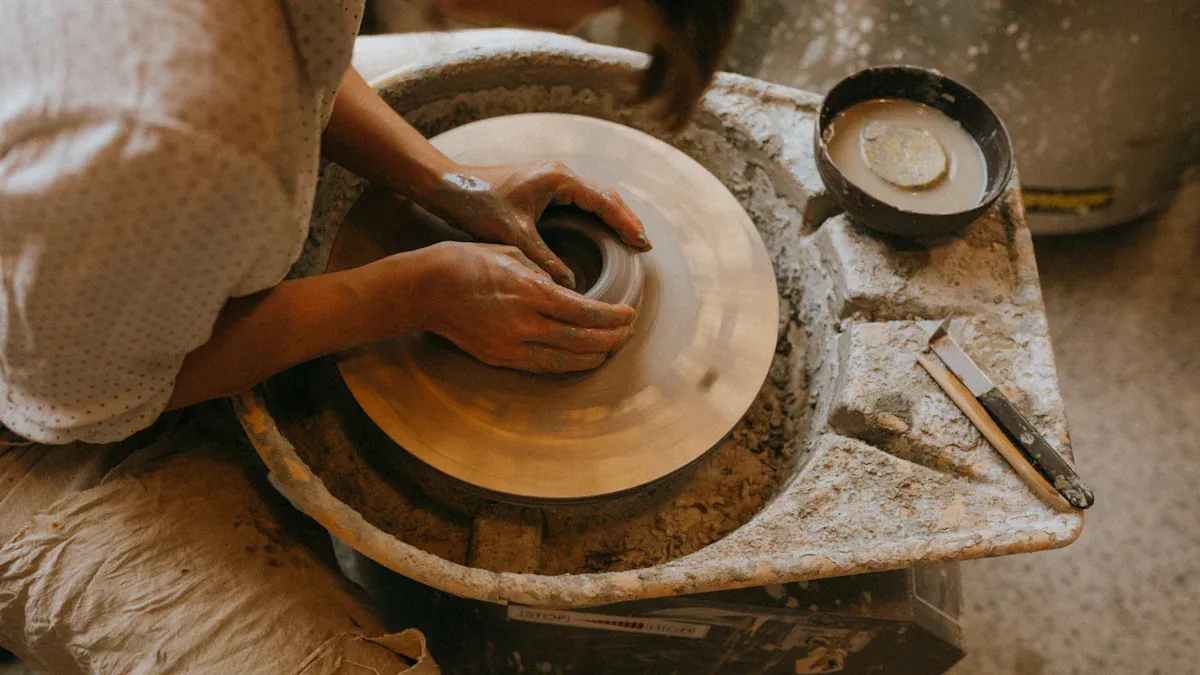
Powder pressing ceramics shapes ceramic powders into solid forms by applying mechanical pressure. This process creates components with high density, precise dimensions, and strong mechanical properties. Manufacturers rely on powder pressing ceramics to optimize production speed and consistency, especially for small and medium-sized parts. The global market reflects steady growth across regions and industries:
| Metric | Value / Description |
|---|---|
| Market Size (2023) | USD 179 million |
| Projected Market Size (2032) | USD 217.17 million |
| CAGR (2025-2033) | 2.8% |
| Key Sectors | Automotive, medical, electronics, and advanced materials |
Powder pressing ceramics offers short cycle times, easy automation, and reliable quality, making it essential in modern manufacturing.
Key Takeaways
- Powder pressing ceramics shapes ceramic powders into strong, precise parts by applying pressure, making it ideal for small to medium production runs.
- Different pressing methods—dry, wet, and isostatic—offer options for shaping simple to complex Ceramic Parts with varying uniformity and automation levels.
- Careful powder preparation, including particle size control and moisture management, is crucial to produce dense, defect-free ceramic components.
- Proper mold design and controlled pressing pressure help ensure uniform density, reduce defects, and improve the quality of ceramic parts.
- Powder pressing ceramics delivers high strength, dimensional accuracy, and cost-effective production for industries like electronics, automotive, medical, and aerospace.
Types of Powder Pressing Ceramics
Powder pressing ceramics uses several distinct methods to shape ceramic powders into precise forms. Each method offers unique advantages and suits different manufacturing needs.
Dry Pressing
Dry pressing stands as the most common technique in powder pressing ceramics. Manufacturers use rigid steel dies and punches to apply uniaxial pressure to dry ceramic powders. This method works best for simple or moderately complex shapes, such as tiles or discs. Dry pressing allows for quick production cycles and easy automation, making it ideal for high-volume manufacturing. However, density gradients often develop within the pressed part due to uniaxial pressure and friction against the die walls. These gradients can lead to inhomogeneity and limit the complexity of shapes produced.
Wet Pressing
Wet pressing involves mixing ceramic powders with a liquid, usually water, to form a pliable mass. The addition of fluid improves powder flow and compaction, which can help reduce defects. Tooling for wet pressing closely resembles that used in dry pressing. This method can accommodate more intricate shapes than dry pressing, although it is less commonly used for mass production. Wet pressing also requires careful drying to remove excess moisture before Sintering.
Isostatic Pressing
Isostatic pressing applies hydrostatic pressure uniformly in all directions using a flexible elastomeric mold. This method produces parts with highly uniform density and allows for complex shapes, including tubes and axisymmetric components. Isostatic pressing comes in two main forms: wet bag and dry bag. Wet bag pressing suits large parts but offers less automation, while dry bag pressing supports higher production rates for smaller parts. The process can reach pressures up to 400 MPa, resulting in dense, high-quality ceramic components.
The table below summarizes key differences among these methods:
| Parameter | Dry Pressing | Wet Pressing | Isostatic Pressing |
|---|---|---|---|
| Pressure Application | Uniaxial | Uniaxial + Fluid | Hydrostatic (all sides) |
| Tooling | Rigid dies/punches | Similar to dry | Elastomeric molds |
| Shape Complexity | Simple/moderate | Moderate | Complex |
| Uniformity of Compaction | Density gradients | Improved | Highly uniform |
| Automation | High | Moderate | Varies (wet/dry bag) |
Powder Pressing Ceramics Process

Powder Preparation
Successful powder pressing of ceramics begins with careful powder preparation. Technicians select raw materials such as oxides, carbides, or nitrides based on the desired properties of the final product. They then blend these powders to achieve a homogeneous mixture. The particle size distribution plays a crucial role in this stage. Mixing coarse particles (1–5 μm) with fine particles (0.1–1 μm) in a 7:3 ratio increases green density and reduces shrinkage during sintering. For advanced ceramics like silicon carbide, a three-level particle size distribution (0.5 μm, 1 μm, 3 μm in a 2:5:3 ratio) enhances flexural strength.
Technicians often add binders or plasticizers to improve powder flow and compaction. Moisture content also requires strict control. An optimal range between 0.5% and 1.5% ensures good flowability and prevents defects. Excess moisture can cause steam bubbles and voids, while powders that are too dry may crack during pressing. Submicron particles, especially those between 100 and 300 nm, offer the best balance between processability and final microstructure.
Tip: Consistent particle size and moisture control lead to higher green density and fewer defects in the final ceramic component.
Pressing and Compaction
After preparing the powder, operators load it into a die or mold. Uniform die filling is essential for consistent density throughout the part. The pressing method—dry, wet, or isostatic—determines the type of pressure applied. Pressures can range from 10 MPa in hot pressing to over 400 MPa in hot isostatic pressing. For example, hot isostatic pressing may use 207 MPa of argon gas at 1800°C to fully densify advanced ceramics.
The compaction pressure directly influences the density and mechanical properties of the green body. As pressure increases, bulk density rises and porosity decreases. Fracture strength and Young’s modulus improve with higher density, but these properties plateau beyond a certain pressure. Operators must also monitor the pressing rate. Pressing too quickly can hinder densification, while optimal rates promote uniform compaction.
Moisture content continues to affect this stage. Properly controlled moisture reduces agglomerate resistance and improves compaction. However, excessive moisture can cause defects, and insufficient moisture may lead to cracks.
Typical Pressing Methods and Pressure Ranges:
| Pressing Method | Pressure Range | Notes |
|---|---|---|
| Hot Isostatic Pressing (HIP) | 70–400 MPa | Uniform gas pressure, high densification |
| Hot Pressing | 10–30 MPa | Simultaneous heat and pressure |
| Cold Isostatic Pressing (CIP) | Up to ~207 MPa | Room temperature, flexible molds |
| Hydrothermal Isostatic Press | ~40 MPa | Lower temperature, specialized applications |
Removal from the Mold
Once compaction is complete, technicians remove the green body from the mold. This step requires precision to avoid introducing defects. Common issues include burrs, flash, and ejection cracks. Burrs and flash often result from poor mold design, inconsistent material flow, or uneven pressure. Ejection cracks occur when friction between the part and the die, combined with residual stresses, causes the part to crack during removal.
Delamination can also arise, especially in materials like zirconia, if powder fluidity or mold finish is inadequate. The pressurization method, speed, and holding time all influence the likelihood of defects. For example, pressing too quickly or using insufficient holding time can trap gases, leading to bubbles or stratification.
Note: Proper die design, lubrication, and controlled ejection forces help minimize defects during mold removal.
Operators may perform additional steps such as drying, glazing, or surface finishing before the final sintering stage. Each step in the powder pressing ceramics process builds on the previous one, ensuring the production of dense, high-quality ceramic components.
Sintering
Sintering transforms the compacted ceramic powder, known as the "green body," into a dense, strong, and durable final product. This stage plays a critical role in powder pressing ceramics, as it determines the mechanical strength, microstructure, and appearance of the finished component.
During sintering, technicians heat the green body to a temperature below its melting point. The particles bond together through diffusion, which reduces porosity and increases density. Most Ceramic Materials require sintering temperatures between 1000°C and 1800°C. The exact temperature depends on the type of ceramic and the desired properties. For example, clay-based ceramics often sinter at about 50% to 75% of their melting temperature, which ensures optimal densification without causing the part to lose its shape.
The sintering process involves several key factors:
- Ramp Rate: Technicians must control the rate at which the temperature increases, especially from 900°C to the peak temperature. A slow ramp rate prevents thermal shock and cracking.
- Hold Time: Maintaining the peak temperature for a specific period allows the particles to bond fully. This step improves the strength and density of the ceramic.
- Cooling Rate: Gradual cooling prevents warping and internal stresses, which can lead to defects.
Atmosphere control is another essential aspect of sintering. The choice of atmosphere—such as air, inert gas, reducing gas, or vacuum—affects the chemical reactions that occur during heating. For example, steel parts typically sinter at 1120°C to 1315°C in a nitrogen-rich or vacuum atmosphere to prevent oxidation. Iron requires a nitrogen/hydrogen mix, while bronze and brass need reducing or inert atmospheres to avoid oxidation or evaporation of alloying elements. Although these examples refer to metals, the same principles apply to ceramics. Using the correct atmosphere helps prevent unwanted reactions, such as oxidation, which can weaken the final product.
The table below summarizes important sintering parameters for ceramics:
| Aspect | Details |
|---|---|
| Sintering Temperature Range | Typically between 1000°C and 1800°C, depending on clay type |
| Relationship to Melting Point | Sintering occurs at 50%–75% of the material's melting temperature |
| Critical Process Factors | Controlled ramp rate, hold time, and cooling rate |
| Impact on Final Product | Higher temperatures improve density and strength; also affect color and surface finish |
| Equipment Considerations | Kilns must reach required temperatures; energy efficiency is important |
Sintering not only increases the density and strength of ceramic parts but also influences their color and surface finish. Higher temperatures usually result in smoother surfaces and more vibrant colors. However, excessive temperatures can cause grain growth or deformation, which reduces mechanical performance.
Tip: Careful control of temperature, atmosphere, and timing during sintering ensures that powder pressing ceramics produce reliable, high-quality components for demanding applications.
Key Factors Affecting Powder Pressing Ceramics Quality
Powder Properties
The properties of the starting powder play a decisive role in the quality of powder pressing ceramics. Particle size and shape directly influence flowability, packing density, and the formation of defects. Spherical particles typically offer better flow and higher bulk density, while irregular shapes can cause lower powder bed densities and increase the risk of cracks due to poor packing and friction. Finer particles, especially those under 20 μm, enhance sinterability and mechanical strength by promoting higher density and faster sintering. However, larger particles improve flow but reduce sinterability. The initial powder bed state, determined by particle size and distribution, is critical for controlling porosity and density in the final product.
- Spherical particles: better flow, higher density
- Irregular particles: lower density, more defects
- Finer particles: higher density, improved mechanical properties
- Larger particles: better flow, lower sinterability
Powder purity also matters. High-purity powders, such as silicon carbide with 99.967% purity, produce ceramics with superior mechanical properties and minimal contamination. In semiconductor applications, high purity ensures reliable performance and prevents metallic impurities from affecting sensitive processes. The microstructure, shaped by powder purity and processing, impacts both mechanical and electrical properties.
Pressure and Compaction
Compaction pressure stands as the most critical parameter for achieving uniform density in ceramic components. Variations in pressure can lead to density gradients, which often result in cracks and distortions after sintering. Low or excessively high pressures worsen non-uniformity, increasing the risk of defects. Die wall friction causes pressure to decrease with depth, creating gradients that affect the final product.
- Compaction pressure influences granule rearrangement, deformation, and fracture.
- Low pressure: granule rearrangement dominates, may improve packing if granules are hard.
- High pressure: granule deformation and fracture reduce porosity but may introduce defects.
- Die wall friction and granule hardness must be controlled to minimize density gradients.
Tip: Optimizing compaction pressure and controlling friction through die design and lubricants help ensure homogeneous microstructure and minimize defects in powder pressing ceramics.
Use of Binders
Binders are essential for improving the green strength of ceramic compacts before sintering. The choice of binder affects plasticity, mechanical strength, and processability. Organic binders like lignosulfonates, polyacrylic emulsions, and polyurethane provide high green strength, enabling machining and reducing the risk of breakage. Inorganic binders such as sodium silicate and bentonite offer moderate improvements but are less effective than organic options.
| Binder Type | Description & Role | Effectiveness on Green Strength |
|---|---|---|
| Lignosulfonates | Water soluble, increases strength, acts as lubricant | High |
| Polyacrylic Emulsions | Water-dispersed, high green strength, machinable | Moderate to High |
| Polyurethane | Strong polymer-ceramic interaction, high green strength | High |
| Polyvinyl Alcohol | Common, water-soluble, low green strength | Low |
| Sodium Silicate | Inorganic, inexpensive, moderate strength | Low to Moderate |
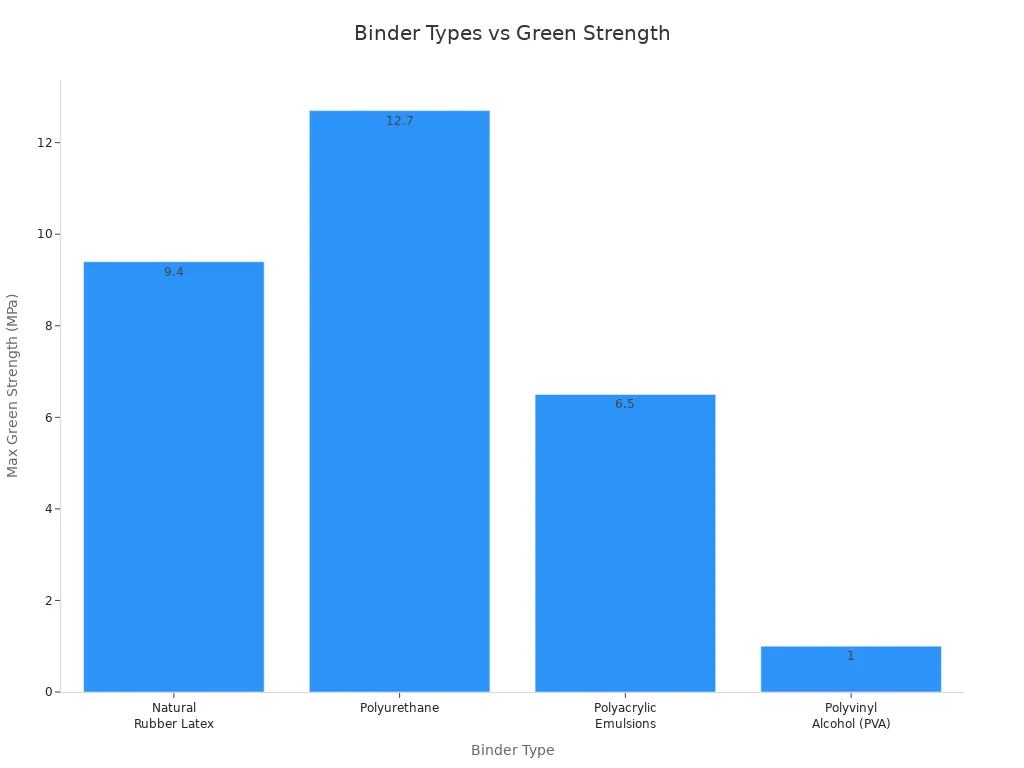
Selecting the right binder and optimizing its content are crucial for achieving the desired mechanical properties and minimizing defects during handling and pressing.
Mold Design
Mold design plays a critical role in the quality and reliability of ceramic components. The shape, size, and surface finish of the mold directly influence powder flow, filling efficiency, and the uniformity of density within the pressed part. Engineers must consider several factors when designing molds for ceramic pressing.
- Experimental studies show that density distribution after pressing closely matches the initial powder fill. If the mold design causes uneven powder filling, these defects persist through the pressing stage.
- Uneven powder filling increases stress variation and density gradients. This leads to cracks and dimensional deformation in the final product.
- Smaller mold diameters reduce fill density. As a result, dimensional accuracy decreases, and the risk of defects rises.
- Wider molds allow better particle rearrangement, which improves fill density and reduces the likelihood of defects.
- Molds with lower aspect ratios (height to width) tend to have reduced fill density. This negatively impacts dimensional stability.
- Deeper molds often result in lower fill densities, contributing to non-uniformity and a higher chance of defects.
- Complex mold shapes, such as those with steps or narrow sections, slow down powder filling. These areas experience increased turbulence and uneven powder distribution, which can cause dimensional inaccuracies and defects.
Surface quality also matters. Smooth mold surfaces help powder flow evenly and reduce friction during pressing. Poor surface finish can trap powder, leading to voids or weak spots in the ceramic part.
Tip: Careful mold design improves powder flow, ensures uniform density, and minimizes defects. Engineers should optimize mold geometry and surface finish to achieve high dimensional accuracy in ceramic components.
Advantages and Disadvantages of Powder Pressing Ceramics
Benefits of Powder Pressing Ceramics
Powder pressing ceramics offers several advantages that make it a preferred method for producing high-quality ceramic components. Manufacturers value this process for its ability to deliver precise, dense, and mechanically robust parts. The following points highlight the main benefits:
- Superior Material Properties: Powder pressing ceramics, especially when using hot pressing techniques, produces parts with high density, strength, and hardness. These properties are essential for demanding applications in electronics, automotive, and medical industries.
- Dimensional Precision: The process allows for tight control over part dimensions. Consistent pressure and well-designed molds help achieve uniform shapes and sizes, reducing the need for extensive post-processing.
- Short Cycle Times: Dry pressing methods enable rapid production cycles. Automation further increases throughput, making the process suitable for low to medium production volumes.
- Versatility in Material Selection: Manufacturers can use a wide range of ceramic powders, including oxides, carbides, and nitrides. This flexibility supports the creation of components with tailored properties.
- Cost-Effectiveness for Specific Volumes: Powder pressing ceramics provides an economical solution for small to medium batch sizes. The method balances material performance with production efficiency, especially when compared to more scalable options like ceramic injection molding (CIM).
- Reliable Quality: The process minimizes variability, ensuring consistent mechanical and physical properties across batches. This reliability is crucial for industries that demand strict quality standards.
Note: Powder pressing ceramics remains the method of choice when high density and mechanical strength are top priorities, even if production volumes are not extremely high.
Limitations and Challenges
Despite its many strengths, powder pressing ceramics faces several limitations and challenges that manufacturers must address to achieve optimal results. These issues can impact both the quality of the final product and the overall cost-effectiveness of the process.
- Achieving homogeneous powder mixtures proves difficult, especially with nanometric powders. Agglomeration and packing uniformity problems often arise, leading to defects in the final product.
- The selection and removal of binders and additives require careful control. Improper binder removal can cause cracks or voids during sintering.
- Controlling the green body’s microstructure and density is complex. Variations at this stage directly affect the strength and reliability of the finished ceramic.
- Producing green bodies with specific microstructures and homogeneity becomes particularly challenging when using advanced shaping methods, such as additive manufacturing.
The table below summarizes some of the most significant industrial limitations:
| Limitation/Challenge | Description |
|---|---|
| Lower accuracy of pressed surfaces | Surfaces adjacent to the flexible mold have lower precision, often requiring additional machining, increasing time and cost. |
| High cost of spray-dried powders | Spray-dried powders needed for isostatic pressing are relatively expensive, raising production costs. |
| Lower production rates | Compared to extrusion or die compaction, isostatic pressing has a slower production throughput. |
When comparing powder pressing ceramics to other forming methods, several cost-related factors emerge. The process often involves longer processing times and higher initial tooling costs. These factors limit its scalability for large-scale production. For example, ceramic injection molding (CIM) offers greater efficiency and material utilization, making it more suitable for both low and high-volume runs. Powder pressing ceramics, on the other hand, fits best for applications where material properties outweigh the need for mass production.
Research also shows that shaping methods influence the microstructure and porosity of ceramic parts. Powder pressing tends to produce slightly higher porosity before sintering compared to extrusion. This difference can affect the final mechanical strength and may require additional processing steps.
⚠️ Manufacturers should carefully evaluate production volume, material requirements, and cost constraints before selecting powder pressing ceramics as their primary forming method.
Applications of Powder Pressing Ceramics

Electronics and Electrical Components
Ceramic components play a vital role in modern electronics. Manufacturers use advanced ceramics to produce substrates, insulators, capacitors, and varistors. These parts must withstand high voltages, provide excellent electrical insulation, and maintain dimensional stability under thermal stress. Ceramics such as alumina and barium titanate offer low dielectric loss and high breakdown strength, making them ideal for circuit boards and microelectronic packaging. The demand for miniaturized, high-performance devices continues to grow, driving innovation in ceramic processing. Asia Pacific leads the market in this sector, fueled by rapid industrialization and the expansion of the semiconductor and photovoltaic industries.
Note: The electronics sector remains a key growth driver for ceramic applications, with thermal management and nitride ceramics showing the fastest market expansion.
Automotive and Aerospace
Automotive and aerospace industries rely on ceramics for their unique combination of strength, durability, and resistance to extreme environments. Engineers select materials like alumina, zirconia, silicon carbide, and silicon nitride for their high hardness, fracture toughness, and thermal shock resistance. These ceramics maintain mechanical strength and dimensional stability at temperatures up to 1600°C. Lightweight properties help reduce overall vehicle weight, improving efficiency and performance.
| Performance Requirement | Description / Relevance in Automotive & Aerospace Applications |
|---|---|
| High Mechanical Strength | Withstands mechanical stresses and shocks. |
| Dimensional Stability at High Temperatures | Maintains shape under extreme heat, critical for engine parts. |
| Lightweight | Reduces component weight, boosting efficiency. |
| High Temperature Resistance | Operates at elevated temperatures, enabling advanced engine designs. |
| Electrical Insulation | Essential for sensors and electronic modules. |
| Corrosion Resistance | Extends component life in harsh environments. |
| Abrasion Resistance | Provides durability for brakes and moving parts. |
| Vibration Resistance | Ensures reliability in engines and structural parts. |
| Thermal Shock Resistance | Endures rapid temperature changes without cracking. |
| High Hardness | Delivers wear resistance for critical components. |
Engineers use ceramics in sensors, heat shields, brake components, and shock absorbers. For example, piezoelectric ceramics in shock absorbers improve ride comfort by adapting to road conditions. The industry emphasizes high-purity raw materials and precise processing to meet strict performance standards.
Medical Devices
Medical device manufacturers depend on ceramics for their biocompatibility, strength, and wear resistance. Ultra-high-purity alumina powders form the basis for surgical tools, diagnostic imaging systems, and implants. The production process combines powder pressing, sintering, and precision machining to create dense, defect-free parts. Quality control measures, such as density measurement using the Archimedes principle and automated testing, ensure consistent mechanical properties and safety.
Regulatory standards like ISO 13485 and FDA-aligned protocols govern every stage of production. Manufacturers must maintain full traceability and comprehensive documentation to support compliance and audit readiness. Strict control over powder purity, particle size, and morphology prevents contamination and device failure. These measures guarantee that ceramic components meet the demanding requirements of the medical field.
Tip: Consistent quality and regulatory compliance are essential for ceramics used in life-critical medical applications.
Industrial and Technical Ceramics
Industrial and technical ceramics play a crucial role in modern manufacturing and engineering. Companies rely on these materials for their exceptional strength, durability, and resistance to extreme environments. Uniaxial pressing stands out as a cost-effective and flexible method for shaping ceramic powders into partially dense "green" bodies. This approach supports the production of bulk ceramics, such as lead zirconate titanate (PZT), and enables large-scale industrial output with short cycle times and precise control.
Hot pressing sintering further enhances the performance of technical ceramics. This process produces dense, durable parts with tight dimensional tolerances. Manufacturers often apply hot pressing to boride, carbide, and nitride ceramics. These materials exhibit outstanding mechanical properties, making them suitable for high-performance applications.
A wide range of industries benefit from powder pressed ceramics. The following sectors frequently utilize these advanced materials:
- Aerospace and automotive: Components must withstand high temperatures and mechanical stress.
- Environmental and manufacturing: Equipment requires corrosion resistance and long service life.
- Electronics and semiconductors: Devices demand electrical insulation and thermal stability.
- Security and protective equipment: Body armor and shields rely on high hardness and impact resistance.
- Mining and heavy industry: Tools and wear parts need abrasion resistance and toughness.
Common ceramic materials include aluminum oxide, zirconia, silicon nitride, graphite, and boron nitride. Engineers select these materials for their ability to meet demanding technical requirements.
| Industry Sector | Typical Ceramic Materials | Key Properties |
|---|---|---|
| Aerospace/Automotive | Silicon nitride, zirconia | High strength, thermal shock |
| Electronics/Semiconductors | Aluminum oxide, boron nitride | Electrical insulation, stability |
| Security/Defense | Alumina, boron carbide | Hardness, impact resistance |
| Manufacturing/Mining | Graphite, silicon carbide | Wear resistance, durability |
Note: The precision and durability achieved through powder pressing methods make technical ceramics indispensable for advanced industrial applications.
Powder pressing ceramics delivers precision, efficiency, and reliable quality for advanced manufacturing. Industries value this process for its ability to meet strict mechanical, thermal, and chemical requirements. To determine if powder pressing ceramics fits a specific application, manufacturers should:
- Define application needs, including mechanical, thermal, and chemical criteria.
- Compare material properties and manufacturing feasibility.
- Assess cost, availability, and regulatory compliance.
This approach ensures optimal performance and cost-effectiveness.
FAQ
What is the main difference between dry pressing and isostatic pressing?
Dry pressing uses uniaxial pressure with rigid dies, which suits simple shapes. Isostatic pressing applies pressure from all directions using flexible molds. This method creates parts with more uniform density and supports complex geometries.
Why do manufacturers add binders to ceramic powders?
Binders increase the green strength of pressed ceramics. They help powders stick together during shaping and handling. Without binders, green bodies may crack or break before sintering.
How does powder particle size affect the final ceramic product?
Smaller particles improve packing density and sinterability. They lead to higher strength and fewer defects in the finished ceramic. Larger particles flow better but may reduce final density and mechanical properties.
Can powder pressing ceramics produce parts for high-temperature applications?
Yes. Powder pressing ceramics creates components that withstand high temperatures. Materials like alumina and silicon carbide maintain strength and stability in extreme environments, making them ideal for engines, furnaces, and aerospace parts.