Mastering Large-Format Powder Metallurgy: A Technical Deep Dive into 150mm Sintered Gear Precision

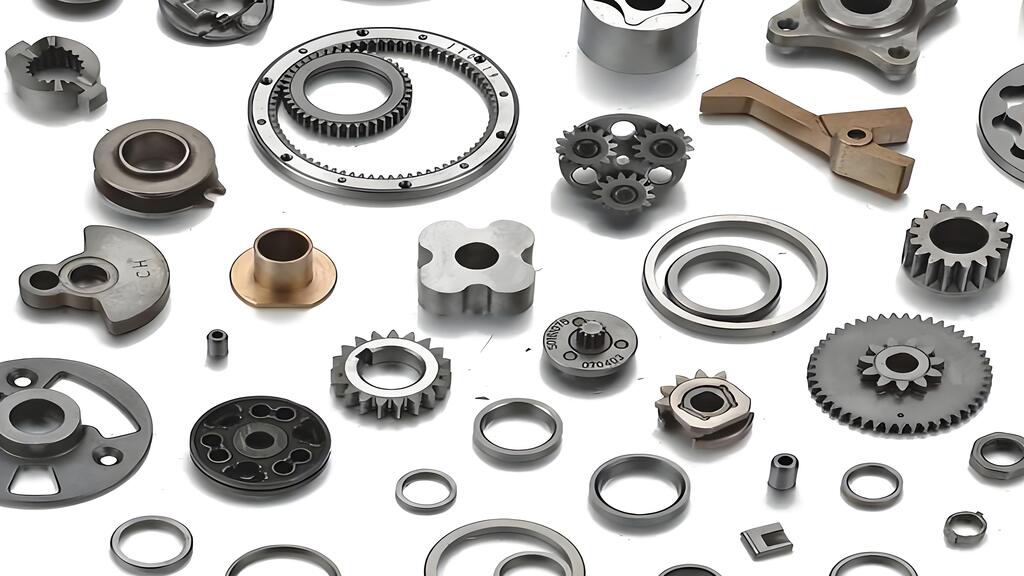
150mm diameter Sintered Gear measurement
In the modern industrial landscape, the transition from traditional subtractive manufacturing (CNC) to additive or near-net-shape processes is accelerating. However, a significant "bottleneck" has long existed in Powder Metallurgy (PM): the difficulty of maintaining dimensional integrity as part size increases.
At Jiehuang, we have broken this barrier. By leveraging a 1,000-ton high-pressure compaction fleet, we are now successfully mass-producing heavy-duty gears and structural components up to 150mm (6") in diameter and 60mm (2.4") in height. This article explores the engineering innovations required to master large-format sintering and why leading OEMs are shifting their high-torque applications to Jiehuang.
The Physics of Scale: Why Large Gears Present a Unique Sintering Challenge
In small-scale MIM or PM (under 50mm), the physics of sintering are relatively forgiving. As the diameter scales to 150mm, two primary forces begin to work against the manufacturer: Internal Density Gradients and Non-Linear Thermal Shrinkage.
When a 150mm gear undergoes sintering, it typically shrinks by 15-20% depending on the alloy (such as 17-4PH or 316L). In a large-format part, even a 0.5% variation in density across the radius results in massive internal stresses. These stresses manifest as warping, "tapering," or tooth profile distortion—failures that often lead standard PM shops to reject large-scale projects.
The Foundation of Precision: 10,000KN (1,000-Ton) Compaction Power

Eliminating the "Neutral Axis" Shift in Large-Diameter Parts
The journey to a perfect 150mm gear begins at the press. To achieve a uniform Green Density (the density before sintering), the compaction force must be absolute.
If the press tonnage is insufficient, the friction between the powder particles and the die walls prevents the pressure from reaching the center of the part. This creates a "soft core" or a density gradient. At Jiehuang, our 1,000-ton automated presses apply a staggering 600-800 MPa of pressure.
This extreme force ensures that the metal powder is packed with clinical uniformity from the gear’s outer teeth to its inner hub. By minimizing the shift in the neutral axis during compaction, we create a "Green Part" that is structurally balanced, ensuring that when it enters the furnace, the shrinkage occurs linearly and predictably.
Advanced Thermal Management: Solving the "60mm Height" Thermal Lag
Atmosphere-Controlled Sintering and Thermal Soaking
A gear with a 60mm vertical profile presents a significant "thermal mass" challenge. In a standard sintering furnace, the exterior of a large part heats up significantly faster than its core. This temperature delta, known as Thermal Lag, is the leading cause of "bowing" or "bell-mouth" distortion.
To solve this, Jiehuang utilizes Multi-Zone Atmosphere-Controlled Furnaces with a specialized Thermal Soaking Protocol:
-
Extended Debinding: We use a slower, multi-stage debinding process to ensure all polymers are removed from the 60mm core without creating internal gas pressure.
-
The "Soak" Phase: Before reaching the final sintering temperature (up to 1350°C), we hold the parts at a plateau temperature. This allows the core of the 150mm gear to equalize with the surface.
-
Controlled Cooling: Large parts retain heat longer. Our furnaces use programmed cooling rates to prevent "thermal shock," which can cause micro-cracking in high-hardness alloys like 17-4PH.
This level of control keeps our 150mm gears within a 0.1% to 0.3% dimensional tolerance, achieving a precision level that was previously only possible via expensive CNC grinding.
Metallurgical Excellence: Achieving Wrought-Steel Performance
Meeting and Exceeding MPIF Standard 35
For heavy-duty gear OEMs, "shape" is not enough—strength is paramount. Large gears in industrial gearboxes or automotive transmissions must withstand extreme torque and fatigue.
By combining high-tonnage compaction with high-temperature sintering, Jiehuang achieves a Sintered Density of 7.2 - 7.5 g/cm³. This represents 95-98% of the theoretical density of the material.
-
17-4PH Stainless Steel: Ideal for high-strength, high-hardness applications where corrosion resistance is also required.
-
316L Stainless Steel: Perfect for marine or medical-grade industrial components requiring superior ductility and acid resistance.
-
Low Alloy Steels: Optimized for case-hardening to achieve maximum surface durability for high-wear gear teeth.
All our processes are validated in our in-house metallurgical lab, ensuring every batch meets the rigorous MPIF 35 specifications.
The Economic Reality: Why Large-Scale PM is Replacing CNC
Historically, 150mm gears were exclusively the domain of CNC hobbing and grinding. However, the economic disadvantage of subtractive manufacturing is becoming harder to ignore.
30-50% Cost Savings through Near-Net-Shape Accuracy
-
Material Utilization: CNC machining can waste up to 60% of a raw steel billet as scrap shavings. Our PM process uses 98% of the raw powder, drastically reducing material costs.
-
Eliminating Multi-Stage Grinding: Because we master the warping issues mentioned above, our gears are delivered Ready-to-Assemble. We eliminate the need for secondary hobbing or tooth-profile grinding.
-
Consolidated Geometry: We can often combine multiple parts (e.g., a gear and a flange) into a single sintered component, further reducing assembly labor for the OEM.
Beyond Gears: A Strategic Partner for Heavy-Duty Structural Parts
While the 150mm gear is our technical "calling card," the same 1,000-ton infrastructure is used to produce a wide array of Large-Scale Structural Solutions:
-
Industrial Flanges: High-pressure resistance with zero porosity.
-
Thick-Walled Valve Bodies: For oil and gas applications.
-
High-Torque Splines: Used in heavy machinery and agricultural equipment.
Partner with Jiehuang for Your Next Large-Scale Project
Precision at scale is no longer a contradiction. Whether you are looking to reduce the "Cost per Piece" of an existing gear or designing a new heavy-duty mechanism from scratch, Jiehuang’s engineering team provides the metallurgical expertise and high-tonnage power you need.