

Tungsten Alloy Sintering Process Explained
Tungsten alloy sintering is a vital manufacturing method. It consolidates tungsten and its alloy powders into dense, high-performance components through controlled heating, typically below the melting point. This Sintering Process is essential for creating materials with exceptional hardness, strength, and wear resistance. The global tungsten market size was $5.66 billion in 2024 and projects to grow to $8.7 billion by 2029, demonstrating the increasing demand for these advanced materials in various industries. Optimized sintering ensures these materials meet stringent performance requirements.
Key Takeaways
- Tungsten alloy sintering makes strong, hard parts. It uses heat to join powders. This process is key for many industries.
- Tungsten is hard to sinter. It has a very high melting point. It also does not easily change shape when heated.
- Good raw materials are important. Pure powder and proper mixing help make good tungsten parts. This sets up the sintering process for success.
- Control heat, air, and pressure. These three things are very important. They make sure the tungsten parts are strong and dense.
- Sintering time matters. Enough time helps parts become dense. Too much time can make grains too big.
- New methods like SPS and microwave sintering are better. They make parts faster. They also make parts stronger.
- Sintering makes tungsten parts better. It makes them dense and strong. It also controls how the material looks inside.
Understanding Tungsten's Unique Properties and Sintering Challenges
Tungsten alloys possess a unique combination of properties. These characteristics make them highly desirable for demanding applications. However, these same properties also present significant challenges during the Sintering Process. Manufacturers must overcome these challenges to produce high-quality components.
Inherent Characteristics of Tungsten Alloys
High Melting Point and Density
Tungsten stands out among metals due to its exceptionally high melting point and density. Pure tungsten has a melting point of 3,422 °C and a density of 19.3 g/cm³. This makes it the metal with the highest melting point. Tungsten-rhenium alloys, such as W-25Re, also exhibit very high melting points, approximately 3100 °C. These alloys find use in rocket nozzles and nuclear applications because of their high thermal shock resistance. Tungsten heavy alloys, containing 90–97% tungsten with nickel, iron, or copper, offer improved machinability and provide radiation shielding.
| Metal | Melting Point (°C) |
|---|---|
| W-25Re | ≈ 3100 |
| Property | Tungsten (W) |
|---|---|
| Density (g/cm³) | 19.3 |
| Melting Point (°C) | 3,422 |
Exceptional Hardness and Strength
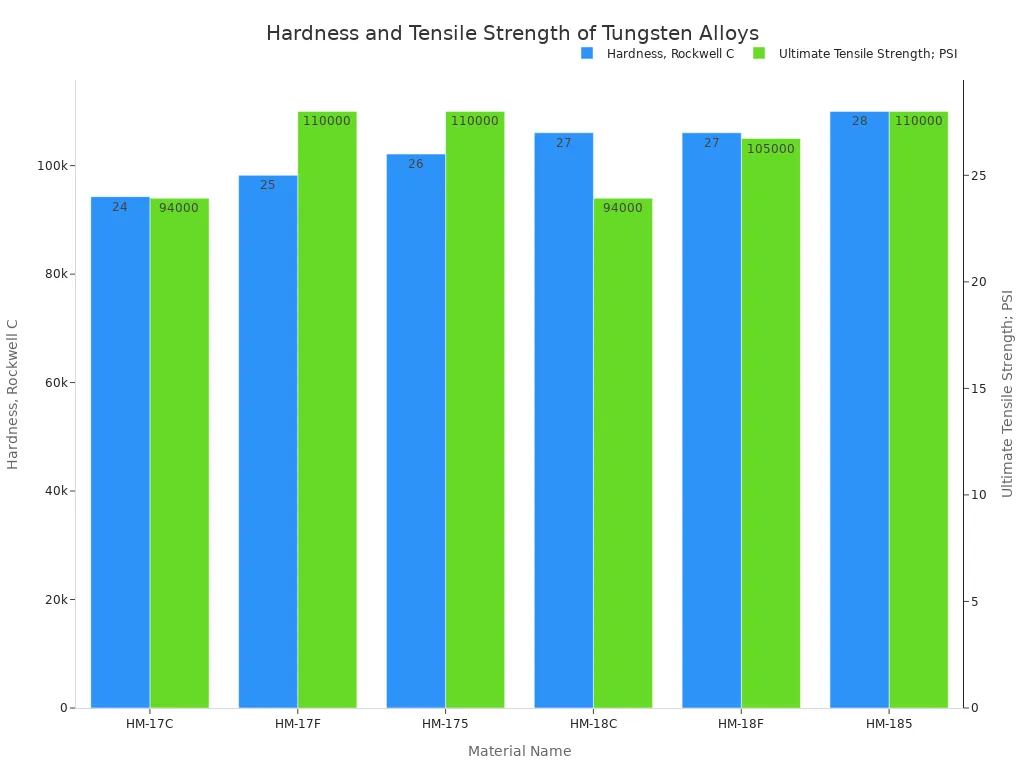
Tungsten alloys are renowned for their outstanding hardness and strength. These properties contribute to their excellent wear resistance and structural integrity. Sintered tungsten heavy alloys typically show Rockwell C hardness values ranging from 24 to 28. Their ultimate tensile strengths are often between 94,000 PSI and 110,000 PSI or even higher, depending on the specific alloy composition. For instance, HM-17F achieves a Rockwell C hardness of 25 and an ultimate tensile strength of ≥110,000 PSI.
In an annealed state, sintered tungsten alloys can have a Vickers hardness of 360 kgf mm⁻². This value increases to 500 kgf mm⁻² when un-annealed. Tensile strength for annealed material ranges from 550-620 MPa, reaching up to 1920 MPa for unannealed material.
| Item | Value (Annealed) | Value (Un-annealed) |
|---|---|---|
| Hardness – Vickers (kgf mm⁻²) | 360 | 500 |
| Tensile strength (MPa) | 550-620 | 1920 |
Difficulties in the Tungsten Sintering Process
Tungsten's unique properties, while beneficial, also pose significant challenges during sintering.
Low Self-Diffusion Rates
Tungsten exhibits low self-diffusion rates. This means tungsten atoms do not easily move and rearrange themselves at elevated temperatures. This characteristic makes achieving high densification challenging during sintering. It requires higher temperatures or longer sintering times compared to other metals.
Brittleness and Oxidation Tendencies
Tungsten alloys are prone to brittleness, especially at lower temperatures. Their high ductile-to-brittle transition temperature (DBTT), typically 300–400 °C, means they become brittle when cooled below this range. Thermal stresses during cooling can induce microcracking and embrittlement. This severely limits room-temperature workability. Impurities, particularly oxygen, at grain boundaries weaken cohesion and promote crack formation. This can lead to intergranular fracture.
Other challenges include:
- Cracking: Thermal gradients during cooling often cause intergranular fracture and microcracking.
- Porosity: Insufficient fusion or improper energy input can lead to various forms of porosity, compromising material integrity.
- Energy Input Issues: Both excessive and insufficient energy input during processing can cause defects like swelling, disturbed melt pools, or interrupted melting tracks.
- Balling: Melted tungsten droplets can solidify into spherical shapes instead of forming a flat layer, negatively impacting density.
Tungsten also shows sensitivity to impurities. These impurities can alter phase behavior or weaken grain boundary cohesion.
Preparing Raw Materials for the Tungsten Sintering Process
Preparing raw materials is a crucial first step in the tungsten Sintering Process. This stage directly influences the final properties and performance of the tungsten alloy components. Careful control over powder production, alloying, and compaction ensures high-quality end products.
Tungsten Powder Production and Characteristics
The quality of tungsten powder significantly impacts the subsequent sintering behavior. Manufacturers focus on purity, morphology, and particle size.
Chemical Reduction and Purity
Producing high-purity tungsten powder often involves chemical reduction methods. The hydrogen reduction method uses hydrogen to reduce tungsten trioxide or ammonium paratungstate. This process typically occurs in two stages: first, tungsten trioxide reduces to tungsten dioxide at 500-700 °C; then, tungsten dioxide reduces to tungsten powder at 700-900 °C. This reaction often takes place in a tube-type electric furnace or a rotary furnace. Other advanced methods, like Chemical Vapor Deposition (CVD,) also produce ultra-pure tungsten. CVD uses tungsten compound gases, such as tungsten hexafluoride (WF6), reduced by hydrogen (H2) at specific temperatures. This deposits tungsten onto a substrate, yielding dense tungsten blanks or finished products. High-purity tungsten powder has a chemical purity of at least 99.99%, with impurity elements present at extremely low concentrations. Spherical tungsten powder, often produced from high-purity sources, maintains a very low level of impurities.
Powder Morphology and Size
Powder morphology and size are critical factors for effective sintering. Spherical particles lead to more uniform packing and consistent sintering behavior due to their consistent shape. This improved flowability benefits powder handling and processing. A higher surface area-to-volume ratio in spherical particles also enhances reactivity and sintering efficiency. A narrow particle size distribution ensures consistent material properties and performance, improving sintering densification and reducing porosity. Finer powder is more conducive to obtaining smaller pore sizes and more complex pore structures. For example, decreasing powder size from 5 μm to 0.6 μm can reduce pore size from 1028 nm to 350 nm at 27% porosity. Ultrafine powders and optimized milling processes reduce activation energy and enhance sintering kinetics through bulk diffusion.
Alloying Element Integration
Integrating alloying elements uniformly into the tungsten powder is essential for achieving desired material properties.
Blending Techniques for Homogeneity
Achieving a homogeneous distribution of alloying elements requires effective blending techniques. Manufacturers select appropriate powder mixers based on powder characteristics and desired mixing outcomes. They consider factors like mixer type, capacity, speed, and agitator design. Common mixer types include tumble mixers, convective mixers, and ribbon blenders. Tumble mixers rotate a vessel, causing powders to intermix, suitable for free-flowing materials. Convective mixers use impellers or blades to create flow patterns, effective for various powder types. Ribbon blenders use helical ribbons to move powder in opposite directions, creating thorough blends. Optimizing parameters such as mixing time, speed, and temperature ensures uniform blends. Coating tungsten powder with a perrhenic acid solution can significantly enhance alloy homogeneity by reducing diffusion distances and promoting pre-alloying.
Role of Additives and Dopants
Additives and dopants play a vital role in enhancing sintering behavior and final properties. Nickel (Ni) is a common dopant. Trace Ni-doped W alloy achieves near-full densification using standard Powder Metallurgy. Nickel atoms segregate at tungsten powder surfaces and transform into Ni-rich grain boundary films during early and intermediate sintering stages. This greatly facilitates mass transport and induces rapid densification. Ni doping drastically reduces the sintering temperature of tungsten; for instance, 0.06 wt% Ni allows 98% densification at 1400 °C, compared to over 2000 °C for pure tungsten. Yttrium oxide (Y2O3) nanoparticles are used to synthesize oxide-dispersion-strengthened tungsten (ODS-W) composites, which offer excellent mechanical properties and stability at high temperatures. Combined additions of zirconium (Zr) and titanium (Ti) to W/Cu/Ni-based alloys result in compact structures and uniform element distribution, leading to superior microhardness and improved electrical conductivity.
Compaction Methods Before Sintering
Compaction transforms loose powder into a "green body" with sufficient strength for handling before sintering.
Cold Isostatic Pressing (CIP)
Cold Isostatic Pressing (CIP) is a widely used compaction method. CIP applies uniform pressure ranging from 5,000 psi to 100,000 psi (34.5 to 690 MPa) to a powder. For tungsten carbide production, a uniform hydrostatic pressure of 200–400 MPa is typical. This method ensures uniform density throughout the green body, reducing internal stresses and improving the final sintered product's consistency.
Uniaxial and Other Pressing Techniques
Uniaxial pressing involves applying pressure in a single direction. This method is simpler and more cost-effective for producing components with simpler geometries. Other pressing techniques, such as warm compaction, combine pressure with moderate heat to improve green strength and density. The choice of compaction method depends on the desired component geometry, material properties, and production volume.
Critical Parameters of the Tungsten Alloy Sintering Process

Controlling critical parameters during the sintering of tungsten alloys is essential for achieving desired material properties. These parameters include temperature, atmosphere, and pressure. Precise management of these factors directly impacts the final density, microstructure, and mechanical performance of the sintered components.
Temperature Control in Sintering
Temperature is a primary factor in the sintering process. It drives the atomic diffusion necessary for densification and grain growth.
Optimal Sintering Temperature Ranges
Determining the optimal sintering temperature is crucial for producing high-quality tungsten alloys. For a 93W6Ni1Co tungsten heavy alloy, researchers identified 1525 °C for 30 minutes as the optimal sintering condition. This condition achieves the desired structural characteristics and improved mechanical properties. Sintering below 1525 °C for 30 minutes often results in inhomogeneous structures with voids and gaps. However, sintering at 1500 °C for at least 60 minutes can achieve comparable effects. This longer duration at a slightly lower temperature may lead to increased microhardness due to tungsten diffusion into the matrix. Sintering at or above 1525 °C promotes the formation of homogeneous structures. These structures feature tungsten agglomerates surrounded by a NiCo matrix.
Heating and Cooling Rate Management
Heating and cooling rates significantly influence the final microstructure and mechanical properties of sintered tungsten alloys. The volume fraction of the matrix and the particle size of tungsten in 90W-7Ni-3Fe alloy remain consistent regardless of heat treatment involving solution treatment at a constant temperature followed by different cooling rates. The alloy's yield and tensile strength also appear independent of the cooling rate. Samples cooled at 3 °C/min in a furnace showed the maximum tensile elongation.
Cooling rate effects on toughness are often attributed to interfacial segregation of impurities. Rapid cooling from a post-sintering anneal can improve toughness. Conversely, slow cooling can lead to embrittlement due to impurity segregation. Microstructural features were essentially unchanged by differing heat treatments. Variables such as composition, hardness, and density do not explain the ductile-brittle toughness transitions with test temperature and cooling rate.
Atmosphere Control During Sintering
The atmosphere surrounding the tungsten alloy during sintering plays a critical role in preventing oxidation and controlling chemical reactions.
Hydrogen and Vacuum Sintering Environments
Hydrogen and vacuum environments are commonly used for sintering tungsten alloys. Hydrogen acts as a reducing agent. It removes oxygen from the powder particles and prevents further oxidation during high-temperature processing. This ensures the purity of the tungsten. Vacuum sintering removes atmospheric gases. This prevents contamination and allows for higher sintering temperatures without undesirable reactions. Both methods promote densification and help achieve the desired microstructure.
Inert Gas Applications
Inert gases like argon are preferred for high-temperature processes, such as tungsten alloy sintering. Argon remains completely inert at all temperatures. This is crucial because it prevents reactions with metals that could lead to impurities. Unlike nitrogen, which can become reactive under extreme heat and form nitrides with metals, argon's full outermost electron shell makes it chemically stable. This stability ensures argon acts solely as a physical barrier. It displaces atmospheric oxygen and moisture without bonding with the materials being processed. This is vital for maintaining the purity and structural integrity of the final product. It prevents issues like embrittlement and ensures strong, ductile results. This is similar to its benefits in high-temperature welding and additive manufacturing.
| Aspect | Argon | Nitrogen |
|---|---|---|
| Chemical Reactivity | Completely inert, no reactions at any temperature | Can form nitrides with metals at high temperatures |
| Cost | More expensive due to rarity | Cheaper, abundant |
| Density | ~40% denser than air, better shielding | Slightly less dense than air |
| Ideal Applications | High-temperature welding, semiconductor fabrication, and additive manufacturing | Food packaging, tire inflation, and general purging |
Pressure Application in the Sintering Process
Applying pressure during sintering can significantly enhance densification and improve mechanical properties.
Hot Isostatic Pressing (HIP) Benefits
Hot Isostatic Pressing (HIP) is a powerful technique that applies high pressure and temperature simultaneously. HIP consolidates metal powders into fully dense, high-performance materials. This is particularly important for materials like superalloys, tungsten carbides, and high-strength steels. HIP processing can achieve complete densification for tungsten grains. Increasing the HIP temperature allows for finer control over the tungsten grain size. It also increases the final density of W-CeO2 composites. The addition of CeO2 significantly increases the Vickers hardness compared to pure tungsten. This demonstrates improved mechanical performance. Researchers can tailor the properties of tungsten through CeO2 content. Low CeO2 concentrations offer the best combination of properties and structure.
Pressureless Sintering Considerations
Pressureless sintering is a simpler and more cost-effective method. It does not require external pressure during the sintering process. Conditions for feasible pressureless sintering of tungsten include utilizing a two-step sintering process. Sieving initial powders to remove large particles or agglomerates is also important. Optimizing processing conditions can achieve high density (>99%) and ultrafine grain size (290 nm) with a uniform microstructure.
Limitations of pressureless sintering, especially with nanopowders, include lower packing density in the green body compared to coarse powders. The benefits of nano-size are rapidly exhausted. Large capillarity forces can lead to fast grain boundary migration. This can cause pore-grain boundary separation, in-grain porosity, and heterogeneous sintering. A relatively high critical density (e.g., 89% for tungsten) is needed to initiate the second-step sintering for full densification. This is higher than for many ceramic systems. Challenges also exist in suppressing grain growth during the second step to maintain ultrafine grain sizes. Higher temperatures required for full densification can lead to grain coarsening (e.g., from 530 nm to 700 nm).
Sintering Time and Its Optimization
Sintering time is a crucial variable in the overall Sintering Process. It directly affects the final density, microstructure, and mechanical properties of tungsten alloys. Manufacturers must carefully control this parameter to achieve optimal material performance.
Duration's Impact on Densification
The duration of sintering directly influences the final density of tungsten alloys. Longer sintering times allow more atomic diffusion. This promotes better particle bonding and more effective pore elimination. Insufficient sintering time results in incomplete densification. This leaves residual porosity within the material. Conversely, excessive sintering time can lead to undesirable grain growth. This negatively impacts the mechanical properties of the alloy. Manufacturers must balance sintering time with temperature. Higher temperatures can reduce the required sintering time for achieving similar densification levels. This careful balance ensures the material reaches its target density without compromising other critical characteristics.
Holding Time for Microstructure Development
The holding time, also known as soaking time, at the peak sintering temperature is critical. It shapes the material's microstructure. During this period, grains grow, and pores shrink and disappear. Optimal holding times ensure a uniform grain size distribution. They also minimize defects. Controlling grain size is vital. Finer grains generally lead to higher strength and toughness in the final product. The holding time also allows alloying elements to diffuse thoroughly. This creates a homogeneous phase distribution throughout the material. This homogeneity is essential for consistent material performance and reliability in demanding applications.
Mechanisms and Advanced Methods in the Tungsten Sintering Process
Understanding the fundamental mechanisms driving the consolidation of tungsten powders is crucial for optimizing the Sintering Process. Advanced techniques build upon these principles, offering innovative ways to achieve superior material properties.
Fundamental Sintering Mechanisms
Sintering involves complex atomic movements and microstructural changes. These changes transform loose powder into a dense, solid component.
Diffusion and Mass Transport
Diffusion and mass transport are the atomic-level processes responsible for densification during sintering. Atoms move from areas of high chemical potential to areas of lower potential. This movement facilitates the growth of necks between powder particles and the shrinkage of pores. Several diffusion paths contribute to mass transport:
- Surface Diffusion: Atoms move along particle surfaces, contributing to neck growth but not densification.
- Grain Boundary Diffusion: Atoms move along grain boundaries, leading to both neck growth and pore shrinkage.
- Volume Diffusion: Atoms move through the bulk of the crystal lattice, contributing to densification, especially at higher temperatures.
These mechanisms work concurrently. Their relative contributions depend on temperature, particle size, and the presence of alloying elements.
Grain Growth and Pore Elimination
Grain growth and pore elimination are critical microstructural changes during sintering. Grains coalesce and grow larger, while pores shrink and eventually disappear. However, the interaction between these two processes in tungsten alloys is complex.
| Sintering Temperature (°C) | Density (g/cm³) |
|---|---|
| 1400 | 14.69 |
| 1480 | 14.68 |
| 1560 | 14.51 |
Higher sintering temperatures, while promoting grain coarsening, can paradoxically lead to increased pore retention and lower densities. Trapped gases within residual pores expand at elevated temperatures. This expansion impedes the liquid phase from filling these pores. Consequently, pores remain in the alloy, even as grains grow larger, leading to a decrease in overall density. This phenomenon suggests an inverse relationship where enhanced grain growth at higher temperatures can be accompanied by incomplete pore elimination.
💡 Tip: Controlling the sintering temperature precisely helps balance grain growth and pore elimination, preventing undesirable porosity.
Researchers have found ways to manage grain growth:
- W grain growth in the NiTi binder was suppressed during liquid phase sintering.
- Tungsten heavy alloys with finer W grains could be easily obtained using a NiTi binder.
Common Tungsten Sintering Techniques
Manufacturers employ various sintering techniques to produce tungsten alloys, each with specific advantages for different applications.
Liquid Phase Sintering Explained
Liquid phase sintering (LPS) is a widely used method for tungsten alloys, especially tungsten heavy alloys. This technique involves heating a mixture of tungsten powder and a binder phase (e.g., nickel-iron or nickel-copper) to a temperature where the binder melts. The liquid binder then wets the solid tungsten particles. It facilitates rapid mass transport through solution-reprecipitation. This leads to efficient densification at lower temperatures compared to solid-state sintering. The liquid phase also helps rearrange the solid particles, filling pores and achieving near-full density.
Solid State Sintering Principles
Solid state sintering (SSS) consolidates tungsten powders without forming a liquid phase. Densification occurs through atomic diffusion in the solid state. This process typically requires higher temperatures and longer holding times than liquid phase sintering. SSS is often used for pure tungsten or alloys where a liquid phase is undesirable. It helps maintain fine-grained structures or specific phase compositions. The primary mechanisms involved are grain boundary diffusion and volume diffusion, which drive neck growth and pore shrinkage.
Spark Plasma Sintering (SPS) Advantages
Spark Plasma Sintering (SPS), also known as Field-Assisted Sintering Technique (FAST), offers significant advantages for tungsten alloys. SPS applies a pulsed direct current and uniaxial pressure simultaneously. This generates rapid heating rates and promotes densification in a very short time. Key advantages of SPS include:
- Rapid Densification: Achieves high density in minutes, significantly reducing processing time.
- Lower Sintering Temperatures: Often operates at lower temperatures compared to conventional methods.
- Fine Grain Size: Suppresses excessive grain growth, leading to finer microstructures and improved mechanical properties.
- Enhanced Properties: Produces materials with superior hardness, strength, and wear resistance.
SPS is particularly effective for consolidating difficult-to-sinter materials like tungsten and its composites.
Microwave Sintering Innovations
Microwave sintering represents an innovative approach to processing tungsten alloys. This technique uses microwave energy to heat the powder compact volumetrically. Unlike conventional heating, where heat transfers from the surface inward, microwave heating generates heat throughout the material simultaneously. This leads to:
- Faster Heating Rates: Significantly reduces the time required to reach sintering temperature.
- Energy Efficiency: Lower energy consumption due to direct heating of the material.
- Uniform Heating: Minimizes thermal gradients, reducing internal stresses and defects.
- Fine Microstructures: Promotes rapid densification while suppressing grain growth, resulting in fine and homogeneous microstructures.
Microwave sintering holds promise for producing high-performance tungsten alloys with improved properties and reduced manufacturing costs.
Optimizing Material Properties Through the Sintering Process
Manufacturers meticulously control the sintering process to achieve specific material properties in tungsten alloys. This optimization focuses on density, strength, and microstructure.
Achieving High Density and Low Porosity
High density and minimal porosity are critical for the performance of tungsten alloy components.
Factors Influencing Densification
Several factors influence the final density and porosity of sintered tungsten alloys. The specific sintering process plays a significant role. Liquid-phase sintering can lead to tungsten grain growth, collapse, and deformation due to large solid-liquid density differences. This causes tungsten grains to sink and aggregate. Two-step sintering, for example, at 1300–1450 °C for 1 hour followed by 1200–1350 °C for 10 hours, achieves relative densities above 98% and finer grain sizes (0.70–0.95 μm) compared to ordinary sintering. Optimized two-step sintering can even reach 99.3% relative density with a 290 nm grain size. Spark plasma sintering (SPS) combined with hot isostatic pressing (HIP) can achieve a maximum relative density of 91.7% after SPS, increasing to 97.2% after HIP at 1650 °C for 2 hours.
Tungsten content also affects porosity. In W–Ni–Fe alloys prepared by solid-phase sintering, porosity increases with higher tungsten content (60–80% mass fraction), which decreases tensile strength and elongation. Adding other elements can improve densification. For instance, adding copper to 90W–Ni–Fe–Cu alloys via hot isostatic pressing results in relative densities above 98.5%. Increasing copper content leads to higher microstructure density and reduced voids, as copper inhibits tungsten dissolution and precipitation. Adding yttria-stabilized zirconia (YSZ) and rhenium metal by spark plasma sintering also improves relative density.
Processing parameters like pressing pressure, temperature, and holding time are crucial. Increasing pressing pressure from 100–400 MPa enhances the density of pure tungsten billets and sintered bodies, reducing pores. A maximum sintered body density of 18.3 g/cm³ (94.8% relative density) is achievable at 400 MPa. In hot isostatic pressing, increasing both temperature and pressure boosts the relative density of tungsten alloys, with temperature having a greater effect.
Minimizing Residual Pores
Minimizing residual pores and achieving near-theoretical density is essential. Selective Laser Melting (SLM) effectively produces high-density tungsten components. Optimized processing parameters achieve pure tungsten products with a density of 19.01 g/cm³ (98.50% theoretical density). This method forms a high-density microstructure without significant defects like balling or macrocracks. SLM-produced tungsten exhibits mechanical properties comparable to those from conventional methods. Achieving high-density tungsten via SLM requires meticulous parameter design and optimization due to tungsten's intrinsic properties. Key factors include powder characteristics, layer thickness, and laser parameters. These parameters are initially designed through theoretical calculations and then optimized experimentally. While conventional methods often struggle with complex structures and achieving high densities, recent SLM advancements produce high-density pure tungsten parts.
Enhancing Hardness and Strength
Optimizing the sintering process directly enhances the hardness and strength of tungsten alloys.
Microstructure-Property Relationships
The microstructure of sintered tungsten alloys directly correlates with their hardness and strength. For example, Sm2O3 core–shell powders sintered bulk show finer tungsten grains (9.64 ± 3.36 μm) and lower porosity (4.39%) compared to pure tungsten powders (11.69 ± 4.70 μm, 7.48% porosity). This leads to significantly improved crack resistance. Sm2O3 concentrates at tungsten grain boundaries, causing crack propagation along wavy paths, exhibiting deflection and bridging. These mechanisms enhance elastic failure resistance and crack resistance, improving toughness. Thermo-mechanical treatment also significantly improves yield strength, tensile strength, and elongation to failure by reducing tungsten grain contiguity from 0.7 to 0.3 and slightly decreasing the volume fraction of tungsten grains.
Grain Size Control
Controlling grain size during tungsten alloy sintering optimizes mechanical properties. Alloying elements like rhenium (Re) and molybdenum (Mo) refine tungsten grains by controlling grain growth. Cobalt (Co) improves the strength of the tungsten-matrix interface and provides solid-solution strengthening. Nickel (Ni) acts as an activation agent, improving sintering kinetics by activating grain boundary diffusion of tungsten. Longer sintering times, however, lead to coarse-grain microstructures and deteriorate mechanical properties. Spark Plasma Sintering (SPS) achieves densification at lower temperatures (1200–1450 °C) and in significantly shorter times due to rapid heating, which aids in grain refinement.
Microstructural Development and Phase Control
Careful control over microstructural development and phase distribution is crucial for high-performance tungsten alloys.
Managing Grain Boundary Movement
Managing grain boundary movement during sintering prevents abnormal grain growth in tungsten alloys. Solid solution grain growth inhibitors, such as VC and Cr3C2, are effective. These inhibitors, when uniformly dispersed, form multi-component Co-(Cr, V)-C liquids at lower temperatures (as low as 1200 °C). This facilitates their effective dispersion within the cobalt-rich liquid phase, eliminating local irregularities that cause abnormal grain growth. This approach also allows full density at lower sintering temperatures (around 1250 °C), minimizing grain growth by a solution/reprecipitation mechanism.
Homogeneous Phase Distribution
Achieving homogeneous phase distribution in multi-phase tungsten alloys during sintering presents challenges. The significant density difference between tungsten and the matrix can lead to gravity-induced grain segregation from the liquid phase. This results in non-homogeneous mechanical properties despite proper tungsten-matrix compositions. Strategies to ensure homogeneity include conducting milling operations in an argon atmosphere to prevent oxidation. This produces a stable and homogeneous alloy powder. Preparing tungsten-base alloys with ultrafine grains, uniformly distributed dispersion phase particles, and high relative density also enhances comprehensive mechanical properties.
An optimized tungsten alloy sintering process offers significant benefits. It achieves material and labor cost savings through near-net-shaped parts. Manufacturers also reduce costs while maintaining component quality due to improved powder quality. This process allows for high precision and intricate shapes with tight tolerances. It also optimizes material utilization for high-density and costly tungsten.
Future advancements in tungsten alloy sintering will focus on novel particle configurations. Core-shell nanopowders, for example, significantly promote the Sintering Process. They achieve full-density, uniform compacts with much smaller grain sizes. This leads to enhanced mechanical properties and clarifies the densification mechanism.
FAQ
What is tungsten alloy sintering?
Tungsten alloy sintering consolidates tungsten and alloy powders into dense, high-performance components. This process uses controlled heating, typically below the melting point. It creates materials with exceptional hardness, strength, and wear resistance for demanding applications.
Why is tungsten challenging to sinter?
Tungsten presents sintering challenges due to its high melting point and low self-diffusion rates. It also exhibits brittleness and oxidation tendencies. These characteristics require precise control of temperature, atmosphere, and pressure to achieve high-quality, dense components.
How does temperature control impact sintering?
Temperature control is crucial for successful sintering. Optimal temperature ranges drive atomic diffusion, promoting densification and grain growth. Precise heating and cooling rates manage microstructure development. This prevents defects and ensures desired mechanical properties in the final alloy.
What is the purpose of atmosphere control during sintering?
Atmosphere control prevents oxidation and manages chemical reactions. Hydrogen acts as a reducing agent, removing oxygen. Vacuum sintering removes atmospheric gases, preventing contamination. Inert gases like argon provide a stable, non-reactive environment, maintaining material purity and integrity.
What are the advantages of Spark Plasma Sintering (SPS)?
Spark Plasma Sintering (SPS) offers significant advantages. It achieves rapid densification at lower temperatures and in shorter times. SPS suppresses excessive grain growth, leading to finer microstructures. This results in materials with superior hardness, strength, and wear resistance.
How does sintering optimize material properties?
Sintering optimizes material properties by achieving high density and low porosity. It enhances hardness and strength through controlled microstructure development. Managing grain size and ensuring homogeneous phase distribution are key. This process creates high-performance tungsten alloy components.
Why is raw material preparation important for sintering?
Raw material preparation is a crucial first step. It directly influences the final properties of tungsten alloy components. Careful control over powder purity, morphology, and particle size ensures effective sintering. Proper blending of alloying elements also guarantees homogeneity.