

Why Lightweight Powder Metallurgy Parts Are Essential for Next-Generation Electric Vehicles

Why Electric Vehicles Need Lightweight Metal Components

Battery Weight Compensation Requirements
Battery packs represent one of the heaviest components in electric vehicles. They account for 20-25% of total curb weight. These power systems can weigh hundreds of kilograms and create direct effects on vehicle performance characteristics. Range, braking distance, and tire wear all suffer. Battery packs and electric motors make EVs 15-33% heavier than conventional vehicles. This substantial weight addition creates an engineering challenge that just needs careful material selection throughout the vehicle structure.
Lightweight metals become essential to offset this battery mass without compromising vehicle safety or performance standards. Manufacturers reduce weight in non-powertrain components and create opportunities to either install larger battery capacities or maintain existing range with smaller, more economical battery systems. This weight compensation strategy proves especially valuable as battery technology continues evolving. Engineers can maximize efficiency gains from both improved energy storage and reduced structural mass.
Energy Efficiency and Driving Range Impact
The relationship between vehicle mass and energy consumption follows predictable physics principles. A 10% reduction in vehicle weight results in a 6-8% improvement in fuel economy or energy efficiency. Real-life testing confirms these projections. A 15% increase in vehicle weight causes a 4-9% rise in wheel energy consumption. Every kilogram trimmed from structural components translates into extended driving range directly.
Energy efficiency becomes the defining metric for next-generation electric mobility. Lighter vehicles just need less energy to accelerate and decelerate. This reduces the power demands placed on battery systems during operation. This efficiency gain proves most important during highway driving, where aerodynamic drag and sustained speeds demand continuous power output. Lightweight components in one quarter of the vehicle fleet could save more than 5 billion gallons of fuel by 2030.
Regulatory Standards and Sustainability Goals
European regulations impose strict demands on vehicle efficiency, sustainability and material reusability. CO2 standards, Ecodesign requirements and Battery Regulations all play a role. Progressive anti-pollution regulations mandate specific emission reductions. Vehicles registered from 2025 onwards must reduce CO2 emissions by 15%, with requirements increasing to 37.5% for cars by 2035. Weight reduction supports compliance with these regulatory frameworks directly.
Lightweight Powder Metallurgy parts enable manufacturers to meet both performance and environmental objectives. Material efficiency strategies reduce production-phase emissions and operational energy consumption. This lines up vehicle development with global decarbonization targets for the transportation sector.
What Makes Powder Metallurgy Parts Ideal for EVs

High Strength-to-Weight Ratio of Powder Metallurgy Strength
Powder metallurgy delivers exceptional strength-to-weight characteristics through controlled material composition and microstructure development. The compaction and Sintering process creates uniform material properties throughout the component and produces parts with tensile strengths approaching 75% of wrought materials while maintaining lower mass. Heat treatment options improve powder metallurgy strength further and allow manufacturers to tailor hardness and wear resistance for specific EV applications without adding weight penalties. This controlled material development proves especially valuable for transmission gears and structural brackets where load-bearing capacity must be balanced against vehicle mass targets.
Complex Geometry Manufacturing Without Machining
The powder metallurgy process produces components at or close to final dimensions and minimizes machining requirements. Complex shapes that would be impractical or impossible with other metalworking processes become feasible through advanced die design and compaction techniques. Multi-level components, integrated features, and intricate internal geometries emerge from the pressing operation. This capability enables design consolidation, where a single powder metallurgy component can replace multiple machined parts and reduce assembly steps and potential failure points in EV powertrains.
Material Efficiency and Near-Net-Shape Production
Material utilization rates exceed 97% in powder metallurgy operations, with minimal scrap losses compared to subtractive manufacturing. Conventional machining processes can waste up to 80% of raw material. Powder metallurgy parts use more than 97% of the starting material in the finished component. Near-net-shape production eliminates secondary operations that get pricey, as parts emerge from sintering and require little to no finishing work. This material efficiency translates into cost savings on expensive lightweight metals such as titanium and aluminum alloys used in next-generation electric vehicles.
Budget-Friendly Production for Medium to High Volumes
Powder metallurgy part manufacturing proves economically viable for moderate to high-volume component production requirements. Per-part costs decrease compared to casting or forging alternatives once tooling costs are amortized across production runs. The process helps automated production with consistent quality control and produces parts at rates of several thousand per hour for smaller components. This volume efficiency makes powder metallurgy suitable for EV manufacturers scaling production to meet growing market need while maintaining tight cost targets.
Critical EV Components Using Powder Metallurgy Part Manufacturing

Transmission Gears and Powder Metallurgy Gear Systems
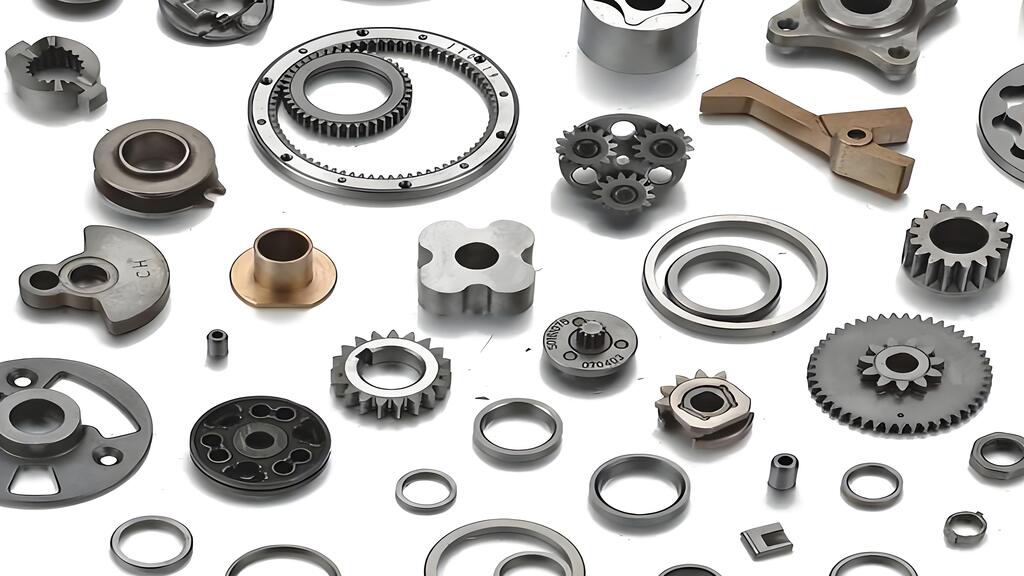
EV transmission systems present distinct demands compared to conventional drivetrains. Gears remain constantly engaged during operation and experience loads on both drive and coast flanks due to regenerative braking requirements. These powder metallurgy gear components are much larger than their internal combustion counterparts, even in smaller electric vehicles, and must deliver reliable performance for at least 300,000 kilometers. Sintered gears with densities exceeding 7.2 g/cm³ achieve the strength-to-weight ratios needed for these continuous-duty applications. The process produces spur and helical gears with tight tolerances and maintains dimensional stability under thermal cycling.
Electric Motor Components and Soft Magnetic Parts
Soft magnetic composites allow advanced motor designs through their unique three-dimensional isotropic magnetic properties. These materials consist of iron powder particles coated with electrically insulating layers that reduce eddy current losses at high frequencies. Axial flux and transverse flux motor topologies benefit from SMC stator designs and create higher torque and power densities compared to traditional radial flux motors. Traction motors, air conditioning compressors, and electric pumps depend on these lightweight powder metallurgy parts for automotive applications. The 3D magnetic flux capability allows compact motor configurations that support space-constrained EV architectures.
Structural Brackets and Mounting Hardware
Powder metallurgy part manufacturing produces structural brackets for engine mounting, chassis reinforcement, and suspension assemblies. These components maintain precise dimensional accuracy and reduce assembly errors while they withstand vibration and thermal expansion. Door lock mechanisms, window regulator gears, and hinge pins represent additional applications where complex geometries and high strength are essential.
Battery Housing Fasteners and Thermal Management Parts
Battery systems require specialized fastening solutions that maintain structural integrity across extreme temperature ranges and load conditions. Thermal management fasteners secure cooling components operating between subzero conditions and temperatures exceeding 100°C during rapid charging. Air cooling system components manufactured through powder metallurgy provide reliable heat dissipation and maintain the lightweight characteristics critical for EV efficiency.
Manufacturing Advantages and Performance Benefits

Reduced Secondary Operations and Assembly Steps
Near-net-shape manufacturing eliminates extensive post-sintering work in most powder metallurgy part manufacturing applications. Components emerge from sintering furnaces at final dimensions and require minimal finishing operations. Sizing operations can improve dimensional accuracy by 50% compared to sintering alone when tight tolerances prove needed. This reduction in machining steps decreases production time and tool wear costs. Part consolidation streamlines assembly further and allows designers to combine multiple components into single lightweight powder metallurgy parts that eliminate fasteners and joining operations.
Consistent Material Properties and Quality Control
Modern CNC compaction presses deliver part-to-part precision through continuous monitoring and automated weight correction systems. Dimensional tolerances range from IT-6 to IT-12, depending on feature orientation and material composition. Statistical process control techniques track powder formulation, density and sintering parameters to maintain uniform mechanical properties in production batches. This repeatability stems from controlled powder characteristics and standardized thermal processing cycles that produce consistent microstructures.
Design Flexibility and Integrated Functions
Complex geometries including internal cavities and multi-level features become feasible without extensive tooling costs. The powder metallurgy gear production process creates shapes impossible through conventional metalworking and enables functional integration that reduces part counts in EV assemblies.
Environmental Benefits of Powder Metallurgy Processes
Material utilization exceeds 97% in powder metallurgy operations. The process consumes 90% less material than machining to manufacture complex components. Energy requirements run 15% lower than conventional manufacturing methods due to reduced processing temperatures and eliminated machining steps. Recyclable metal powders support closed-loop manufacturing systems. Scrap material gets reintroduced into production cycles without property degradation.
Conclusion
Lightweight powder metallurgy parts have become indispensable to next-generation electric vehicles. These components deliver exceptional strength-to-weight ratios and achieve 97% material efficiency. They compensate for battery weight challenges effectively. Companies like Ningbo Jiehuang Chiyang provide complete powder metal manufacturing solutions to produce transmission gears and motor components. Automotive manufacturers can meet stringent efficiency standards through this revolutionary manufacturing technology. Production costs and environmental effects are reduced simultaneously.