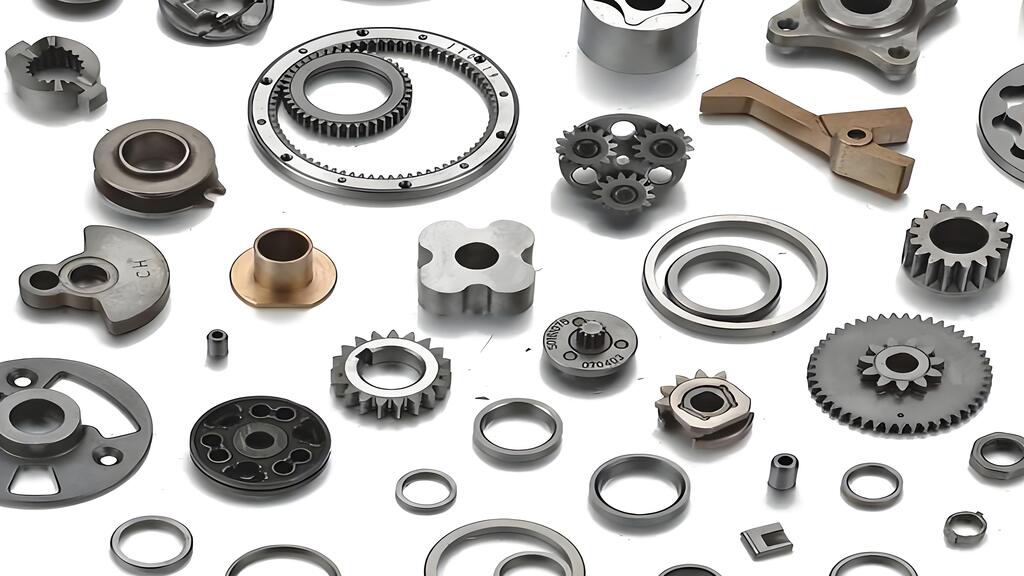


What Is Sintered Metal Product?

Sintered metal products make up a $6 billion global market in 2024, and experts predict it will reach $10 billion by 2034. The manufacturing process uses heat to bond metal powder particles together without melting them completely. This creates strong and precise components.
Metal Sintering has become popular because it's eco-friendly and affordable. The process can create complex-shaped components effectively. The parts show remarkable improvements at high temperatures. Their tensile strength goes up by 30%, bending fatigue strength improves by 15%, and impact energy jumps by 50%. These parts reach dimensional tolerances between IT8 and IT9. After sizing, these tolerances can get even better - reaching IT5 or IT7.
The main goal is to create strong, precise parts that would be tough or expensive to make through machining or casting. Sintering stands as the last major step in Powder Metallurgy. The process will give a reliable end product by cutting down porosity and boosting several properties. These include strength, electrical conductivity, translucency, and thermal conductivity. This piece gets into how manufacturers make sintered metal products, what makes them great, and the cutting-edge techniques that keep finding new uses for them.
How Sintered Metal Products Are Made

The manufacturing of sintered metal products follows a step-by-step process that changes metal powders into strong, functional components. This multi-stage process combines exact engineering controls with carefully adjusted heat treatments to create parts with exceptional properties.
Powder blending with alloying elements and lubricants
The process starts with careful selection and blending of metal powders. Base metals like iron, nickel, or copper mix with alloying elements such as chromium, manganese, and silicon to boost specific material properties. Lubricants fill gaps between powder particles to improve density and compressibility. They also reduce friction between the die wall and powder during later processing. Zinc stearate and wax-based compounds serve as common lubricants that burn off completely during sintering without leaving any residue.
Compaction into green parts under 400–800 MPa pressure
The powder mixture then goes through compaction in a die press. Softer metals just need pressures between 200-400 MPa, while harder metals like steel require higher pressures from 400-800 MPa. Pressure turns loose powder into a "green compact" that holds its shape but isn't strong enough for practical use. The density we achieve during compaction substantially affects the final properties of sintered parts.
Controlled atmosphere sintering below the melting point
Green compacts move into a sintering furnace where they heat up to about 70-90% of the metal's melting point. This key temperature—usually between 1150-1300°C for stainless steels—allows solid-state diffusion without melting. The furnace needs a carefully controlled atmosphere. Nitrogen and hydrogen mixtures help prevent oxidation and aid oxide reduction on particle surfaces. Metal particles create "necks" between adjacent particles during this stage and progressively bond together as material spreads between them.
Cooling zones to prevent oxidation and preserve properties
The final stage uses controlled cooling to preserve the new microstructure and prevent oxidation. Most furnaces use multiple cooling zones with carefully managed atmospheres. Adding 20% dry nitrogen to the cooling zones prevents re-oxidation while maximizing cooling rates. This careful cooling process locks in the microstructure, relieves internal stresses, and gives dimensional stability to the finished sintered metal parts.
Sintering vs. Melting: Key Differences in Manufacturing
Sintering and melting processes both change metal materials, but they work in completely different ways. These differences clarify why sintered metal products offer unique benefits for specific uses.
Temperature thresholds: 70–90% of the melting point in sintering
Sintering works at temperatures that are nowhere near the material's melting point, staying between 70% and 90% of the melting temperature. To cite an instance, iron-based parts need temperatures of 2050-2150°F, while stainless steel parts might need temperatures that exceed 2300°F. Melting needs much more energy because it heats materials until they turn liquid. This temperature gap is a big deal as it means that everything from energy use to final product qualities changes.
Bonding by diffusion vs. full liquefaction
The core of sintering lies in creating bonds through atomic diffusion without turning materials liquid. Heat and pressure make atoms move between touching particles to form "necks" that get stronger with time. This process keeps the original particle structure while building strong connections. Melting works differently by breaking down the entire crystalline structure as materials become liquid. The internal bonds completely loosen up, which lets materials mix fully and reform when cooled. Each bonding method creates its unique microstructural patterns.
Material efficiency and shape complexity comparison
Sintered metal manufacturing stands out with over 95% efficiency compared to traditional methods. The process makes shared production of complex geometries with intricate details possible, which melting-based processes struggle to achieve. Melted and cast materials often show higher density and tensile strength, but sintered parts maintain more consistent properties throughout. On top of that, sintering needs less finishing work than casting, which often requires extensive machining. These advantages make sintering the perfect choice to produce complex parts with tight tolerances in high volumes.
Performance Benefits of Sintered Metal Parts
Sintered metal parts excel in production efficiency and provide unique performance advantages that make them valuable in a variety of industries.
Dimensional accuracy: IT8–IT9 tolerances
Sintered metal components achieve exceptional dimensional precision with standard tolerances from IT8 to IT9. These tolerances can improve by a lot to IT5-IT7 after sizing processes, and small parts can achieve tolerances as tight as ±5 μm. This precision ensures reliable performance when exact specifications are needed. The tolerances depend on powder characteristics, compaction pressure, and sintering conditions.
Self-lubricating properties from interconnected pores
The interconnected pores in sintered parts can be oil-impregnated to create self-lubricating capabilities. These porous networks store lubricants within their structure and release oil gradually during operation. This maintains consistent lubrication without external maintenance. Jiehuang Chiyang, a leading powder metallurgy company in China, has spent over 20 years manufacturing these high-performance components.
Mechanical strength from sintered neck formation
"Necks" form between adjacent particles during the sintering process. Sintered parts reach 85-95% of the wrought metals' strength. These connections strengthen structural integrity and lower oxidation risk.
Green technology: 95%+ material utilization
Sintered metal manufacturing is environmentally responsible with material utilization that exceeds 95%. This is a big deal as it means that waste is minimal compared to traditional metalworking processes.
High-Temperature and Advanced Sintering Techniques
Manufacturers now challenge the limits of what's possible with advanced sintering methods that improve material properties beyond traditional techniques.
High-temp sintering: 2050–2500 °F for iron-based parts
Powder metal parts typically go through sintering at 2050°F, while ultra-high-temperature sintering (UHTS) reaches 2500°F. Higher temperatures change sintered metal components significantly and boost ultimate tensile strength from 162,000 psi to about 215,000 psi. UHTS also improves elongation characteristics that provide better damage tolerance. Some applications can use sintered soft magnetic materials with better magnetic permeability thanks to this higher processing temperature.
Spark plasma sintering for nanomaterials
Spark plasma sintering (SPS) sends pulsed direct current through both die and powder to generate internal Joule heating. This method achieves near-theoretical density at lower temperatures than standard approaches. SPS completes consolidation in minutes instead of hours with heating rates up to 1000 K/min. This quick process preserves nanoscale structures while improving magnetic, piezoelectric, and thermoelectric properties.
Liquid phase sintering for composite materials
Liquid phase sintering uses a liquid component (usually 5-15% volume) to speed up bonding between solid particles. Strong bonds form quickly through capillary forces and better diffusion—most densification happens within three minutes. The final microstructure has hard particles embedded in a ductile matrix that offers excellent toughness.
Microwave sintering for energy efficiency
Microwave sintering delivers electromagnetic energy straight to materials and achieves 80-90% volumetric heat efficiency. This hands-off method uses 90% less energy than conventional techniques. Materials like ceramics and metal powders consolidate faster at operating temperatures up to 2000°C.
Conclusion
Sintered metal products are the life-blood of modern manufacturing. The market has grown from $6 billion and experts project it to reach $10 billion by 2034. These products are essential in many industries because they can create complex components with exceptional dimensional accuracy and high strength. The sintering process is eco-friendly too, with over 95% material utilization that meets today's need for responsible manufacturing.
These metal parts get their unique benefits from how they're made. The controlled heating below melting points gives them self-lubricating properties and mechanical strength that matches traditional metalworking methods. Engineers can design parts with IT8-IT9 tolerances that work reliably in tough conditions and need less maintenance.
New sintering techniques keep expanding what these materials can do. High-temperature sintering improves tensile strength and elongation by a lot. Spark plasma sintering keeps nanoscale structures that would be lost in regular processes. Liquid phase sintering creates tough composite structures, while microwave methods use much less energy.
Jiehuang Chiyang stands out as a leading powder metallurgy company in China with over 20 years of manufacturing experience. Companies like this push the industry forward by refining sintering techniques and quality standards.
Sintered metal products show how material science, manufacturing efficiency, and performance come together perfectly. These components will without doubt become even more important as technologies evolve. They serve industries from automotive and aerospace to medical devices and consumer electronics. Traditional manufacturing simply can't match their combination of precision, durability, and sustainability.
Key Takeaways
Sintered metal products offer a revolutionary manufacturing approach that combines precision, sustainability, and performance advantages for complex component production.
• Sintering heats metal powders to 70-90% of melting point, creating strong bonds through diffusion without full liquefaction, achieving 95%+ material efficiency.
• Sintered parts deliver exceptional dimensional accuracy (IT8-IT9 tolerances) and self-lubricating properties from interconnected pores that store oil for maintenance-free operation.
• Advanced techniques like spark plasma sintering and high-temperature processing boost tensile strength by 30% while preserving nanoscale structures for enhanced performance.
• The global sintered metal market is projected to grow from $6 billion to over $10 billion by 2034, driven by demand for complex, precise components.
• Manufacturing process involves powder blending, high-pressure compaction (400-800 MPa), controlled atmosphere sintering, and strategic cooling to prevent oxidation and preserve properties.
This technology represents the future of sustainable manufacturing, enabling production of complex geometries with superior mechanical properties while minimizing waste and energy consumption compared to traditional metalworking methods.
FAQs
Q1. What are the main advantages of sintered metal products? Sintered metal products offer high dimensional accuracy, self-lubricating properties, excellent mechanical strength, and over 95% material utilization. They also allow for the creation of complex shapes that would be difficult or expensive to produce through other methods.
Q2. How does the sintering process differ from traditional metal melting? Sintering occurs at 70-90% of the metal's melting point, creating bonds through atomic diffusion without full liquefaction. This preserves the original particle structure while forming strong interconnections, unlike melting which completely breaks down the crystalline structure.
Q3. What industries benefit most from sintered metal components? Sintered metal components are widely used in automotive, aerospace, medical devices, and consumer electronics industries. Their precision, durability, and ability to create complex shapes make them valuable in applications requiring high performance and reliability.
Q4. How does high-temperature sintering improve metal properties? High-temperature sintering, especially ultra-high-temperature sintering (UHTS), can significantly enhance properties like ultimate tensile strength and elongation. For iron-based parts, UHTS at around 2500°F can increase tensile strength from 162,000 psi to approximately 215,000 psi.
Q5. What is spark plasma sintering and how does it differ from conventional sintering? Spark plasma sintering (SPS) uses pulsed direct current to generate internal Joule heating, achieving near-theoretical density at lower temperatures and in shorter times than conventional methods. This rapid process preserves nanoscale structures and enhances properties like magnetic permeability and thermoelectric performance.